One of the things we love about the auto industry is the way it constantly changes and takes on new technology and ideas. There is no denying that the major trend we are seeing these days, and for the past few years, is the development of hybrids and Electric Vehicles (EVs). While there might not be a huge lineup of Chevy EVs just yet, what we have right now, and what we know about what is coming in the not-too-distant future, are certainly impressive. If you are interested in what the future of the auto industry is going to look like, then the Chevy EVs that are available and in development will certainly give you a good idea.
For the moment, the only Chevy EV currently available is the Chevy Bolt EV, which is an impressive start to their future lineup. On the slate, we know that Chevrolet is working hard to develop a number of new options that will hit showrooms soon, including a larger Bolt Electric Utility Vehicle (EUV), an all-new midsize EUV, and an electric pickup. Visit us at McCluskey Chevrolet to learn more about the Bolt and the rest of the upcoming Chevy EV lineup that will forever change the auto industry.
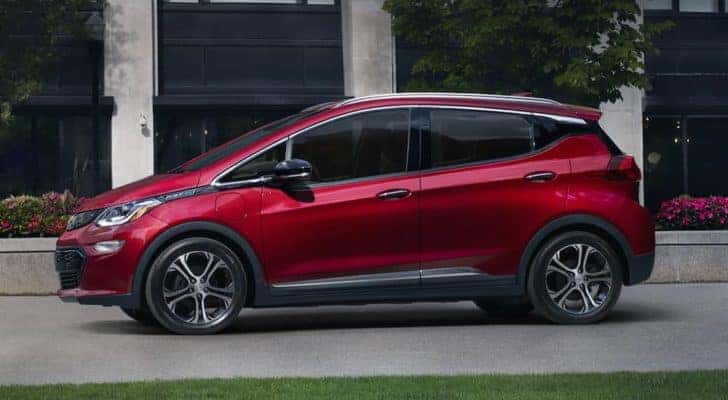
One of the biggest reasons that a lot of people are switching to hybrids and Chevy EVs is for the long-term savings that these vehicles offer. While their MSRP can be higher than a lot of other models – though, to be fair, not much more than many luxury vehicles – you can save a lot of money by skipping the fuel pump. Hybrids offer significantly greater fuel economy than even the most efficient standard, internal-combustion engine, which lets you go longer between fill-ups and save money.
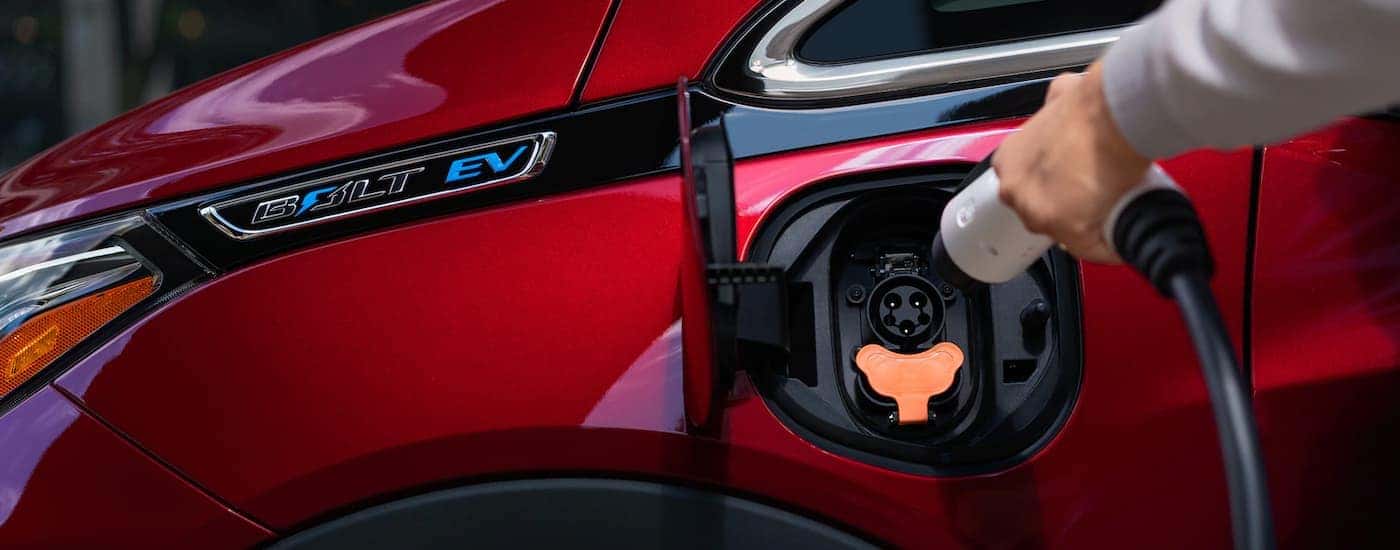
With an EV model, you can completely skip the gas pump and instead simply have to recharge the battery in your vehicle. This can be done through a home connection, as well as at recharge stations located all throughout the country. In general, costs for keeping your vehicle’s battery charged are typically lower than constantly refilling at the gas pump.
Of course, beyond these sorts of concerns, there are larger considerations regarding the health and future of the planet. Vehicles like Chevy EVs run without producing emissions, such as carbon dioxide, that contribute to pollution and global climate change. There is no doubt, at this point, that continued use of fossil fuels in internal combustion engines is not a supportable, long-term method of powering vehicles. So switching to EVs helps reduce pollution and damage to the environment and prepares you for the future of the auto industry.
Speaking of the future, let us take a look at what Chevy has planned for their EV lineup going forward. For now, the Bolt EV is their flagship model and the only one available (we will detail what the Bolt has to offer down below). However, Chevrolet has committed to changing this by introducing a number of other models to create a full EV lineup designed to compete with other auto manufacturers and offer something for everyone.
The first new Chevy EV we are likely to see is an alternative version of their popular Bolt. This is going to be a Bolt EUV, which will be a bit taller and larger than the standard Bolt but built on the same platform as the current Bolt EV. Since it uses the existing platform, rather than requiring the development of a new one, work on this model has been very fast, and the Bolt EUV is expected to be released sometime late in 2021.
If you are interested in more of a dedicated EUV model, then you will be pleased to know that a midsize EUV is currently in development at Chevrolet. While little information has been released on this vehicle, since it is still early in development, we know that it will likely be a midsize model around the same general size as the current Chevy Equinox. This EUV was announced as part of Chevy’s commitment to expanding its EV lineup and should be available by sometime in 2025 at the latest.
Since no Chevrolet lineup could be complete without a hard-working pickup, there is a truck being designed to go along with these other Chevy EVs. Very little has been revealed or announced about their electric truck, though it will likely be a full-size model to compete with the electric F-150 from Ford and the Tesla Cybertruck. Production on this electric truck is expected to begin by 2025, so it will likely see release either late in 2025 or in 2026.

Of course, if you are interested in a Chevy EV that is available right now, then the 2021 Chevy Bolt EV is the way to go. This is an impressive model that continues the improvements of the 2020 Bolt EV, which included a boosted electric range from the previous year. On a full charge, the 2021 Bolt EV can go an EPA-estimated 259 miles without stopping, which places it among the most efficient EV models in its class.
Charging the 2021 Bolt is incredibly simple: it can go about 25 miles after a one-hour charge from a standard unit. A 30-minute charge at a DC fast charging station, however, can get you up to 100 miles of range, letting you easily use the Bolt for getting around town or on long road trips. Not only is it highly efficient, but also incredibly fun to drive as its 200 hp drive system provides you with a responsive, speedy ride that tears up the road.
Inside the Chevy Bolt EV, you will find a number of impressive luxury and technology features, including an available 10-inch Infotainment display, a leather-wrapped steering wheel with mounted controls, and numerous USB ports for charging and data. An available 8-inch configurable driver information display, keyless open and start, remote keyless entry and start, and an available 7-speaker Bose premium sound system make for a truly compelling and enjoyable ride. You can even get a wireless charging pad, so your portable devices can stay charged as they go with you into the future of the auto industry.
Standard safety features on the 2021 Bolt EV include a pedestrian safety signal, LED daytime running lamps, and ten airbags throughout the interior. An HD rear vision camera is standard, as is a Teen driver system that is perfect if you have a new driver behind the wheel. Available safety features include rear park assist, rear cross traffic alert, and lane change alert with a side blind zone alert to help protect you and your loved ones on the road. Automatic emergency braking, a lane keep assist system with lane departure warning, and a forward collision alert are also available.
The all-electric future is rapidly becoming the present, and General Motors has already joined the wider industry's move towards the simpler, faster, and more efficient electric powertrain. A wave of new Chevy EVs is incoming, led by the all-new 2022 Chevy Bolt EV and 2022 Chevy Bolt EUV. The advantages of electric motors and batteries over internal combustion engines and fossil fuels go beyond the obvious.
Naturally, electric vehicles don't put pollution into the already smog-ridden air of cities, but they also offer exponentially greater efficiency than gasoline engines. This mostly comes down to the fact that their operation is digitally precise, without the enormous amount of waste heat that comes from the thousands of explosions that drive conventional engines. Another reason for the greater efficiency is the need for only a few moving parts, while normal engines require a symphony of mechanical connections and components to all work in harmony simply to run.
Chevy capitalized on the capabilities of electric propulsion with the first generation Bolt EV in 2016, one of the first mass-market electric vehicles. Now the time has come for the next generation of Chevrolet electric vehicles, with both a new Bolt EV hatchback and a new Bolt EUV small crossover.
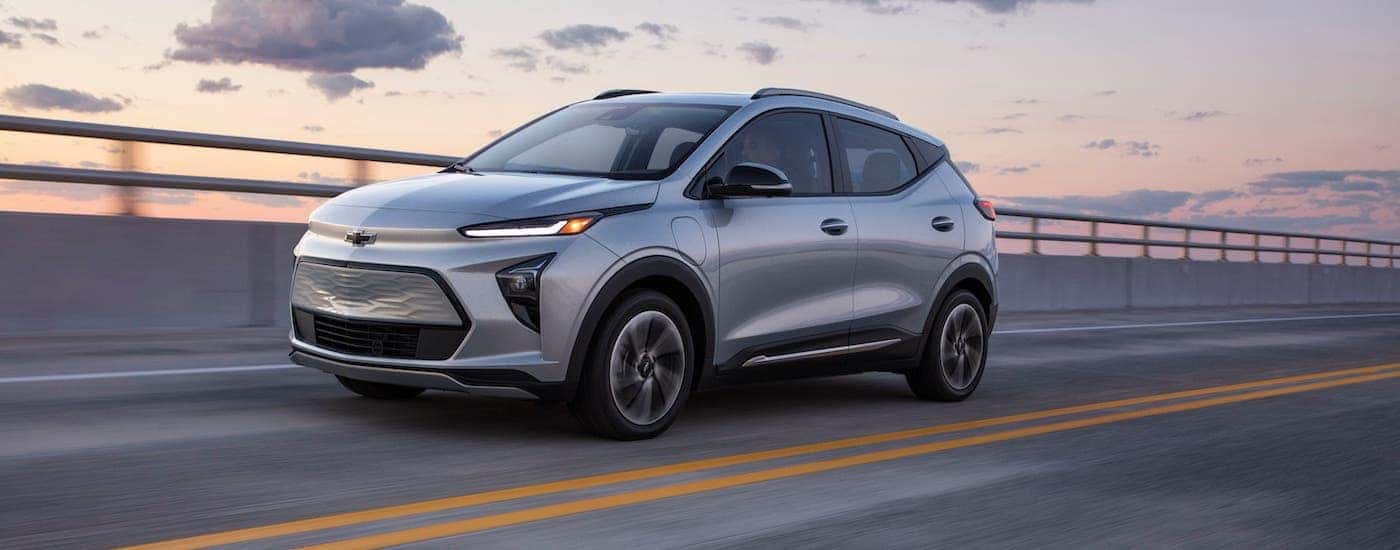
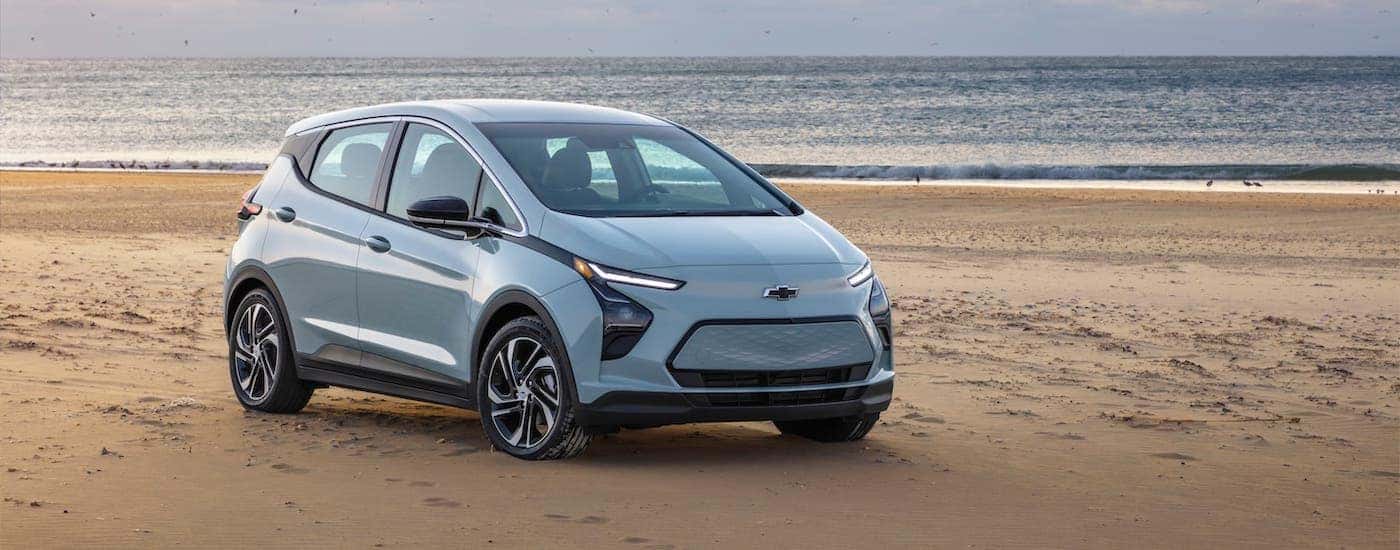
The most apparent changes to the new Bolts are on the outside. The new look for both the standard Bolt EV and the Bolt EUV is noticeably futuristic, with a striking overall aesthetic that is different from anything else on the road today. The overall look between the two vehicles is similar, with many of the same features and elements between the two.
LED lighting is taken further than on most vehicles, with the head and tail lights formed from thin slices of illuminated material that provide an aggressive and sophisticated appearance. LED daytime running lights that double as sequential turn signals are also standard on both the standard Bolt and Bolt EUV. This use of LEDs is part of the overall drive for efficiency, as LEDs use less electricity.
The character lines in the sheet metal of the two Bolts are where they differ significantly. The Bolt hatchback uses angular and creased lines to convey its straightforward and focused image. Meanwhile, the EUV has gentle curves in its side bodywork that hint at its more versatile crossover nature.
Both vehicles are designed to be as aerodynamically efficient as is practical. Elements that were driven by aero considerations include the teardrop-shaped overall profiles of the vehicles, which lower drag and boost aerodynamic efficiency. Both vehicles also use grille-less front ends, as electric vehicles do not require intake air in the same way that normal gasoline-powered vehicles do.
The new Bolt EV and Bolt EUV are even more comfortable than the original Bolt Premier models were. With a design equal parts stylish and practical, the Bolt siblings' interiors are as aesthetically pleasing as they are user-friendly. A 10.2-inch-diagonal infotainment color touchscreen bolsters this user-friendly experience, as well as integrated climate controls and an 8-inch reconfigurable color gauge cluster that allows the driver to keep an eye on the vehicle's status at all times.
Both Bolts house more than enough room to bring family and friends along for a superbly quiet all-electric ride, but the Bolt EUV crossover is designed with three extra inches of rear-seat legroom over its standard hatchback counterpart. That might sound small, but it is the difference between sitting comfortably and feeling almost luxuriously roomy.
Just as the Bolt's passengers are seated in comfort, the driver is given peace of mind through advanced driver-assist features. The Bolt EUV, in particular, will be the first Chevrolet vehicle to be equipped with Super Cruise. Super Cruise is an advanced autonomous driving technology originally developed by General Motors for high-end luxury cars built by Cadillac. With Super Cruise equipped, the 2022 Bolt EUV allows for hands-free driving on over 200,000 miles of mapped highways.
Super Cruise includes a Driver Attention System that helps the driver of the Bolt stay focused on the road, using a camera and infrared lights in conjunction with the unique steering wheel light bar. Additional driver assistance tech included standard on the Bolt siblings includes Automatic Emergency Braking, Forward Collision Alert, Lane Keep Assist with
Lane Departure Warning, a Following Distance Indicator, and Front Pedestrian Braking.
The full list of capabilities is even longer, but rest assured that a properly equipped Bolt EV or Bolt EUV will be able to avoid many kinds of common accidents even without driver intervention. Overall, the Bolt's interior remains a safe and comfortable place to be.
The power of the 2022 Bolt siblings comes from the same proven power pack that motivated the original Bolt. Having very quickly become one of General Motor's most versatile propulsion systems, the batteries and 200 horsepower electric motor that power the Bolt have already found their way into some other vehicles built by GM. These include custom car builds like an electric off-road truck, proving the robust capabilities of the system.
That 200 horsepower is accompanied by an instant surge of 266 pound-feet of torque, which is enough to make the new Bolt siblings throw their occupants back into their seats when the accelerator pedal is floored. This is true even though the batteries of the Bolt EV and Bolt EUV make them noticeably heavier than standard vehicles of their size. But due to the properties of the electric powertrain, the Bolt siblings are much faster than equivalent compact vehicles. They are even capable of outrunning older sports cars and muscle cars from a standing start.
Special abilities of the Bolts' powertrain include Regen on Demand, which allows the driver to reverse the vehicle's electric motor, generating power while decelerating. This is done by using a paddle on the steering wheel and can be turned on and off as seamlessly as the brakes. Another capability that electric propulsion gives the Bolt EV and Bolt EUV is one-pedal driving.
Similar to Regen on Demand, one-pedal driving is a driving mode where the driver effectively never needs to use the brakes. Instead, you can slow the car and recapturing power by merely lifting off the accelerator pedal. This mode is surprisingly intuitive, and its ease of use will very quickly make gasoline cars and crossovers feel antiquated.
The Bolt EV and Bolt EUV are made with lithium-ion batteries that house a total of 65-kilowatt hours of energy, or enough to propel the Bolt EV for 259 miles and the Bolt EUV for 250 miles. While best charged at home overnight for the lowest possible costs and greatest possible convenience, a public DC fast charger can provide a Bolt EUV with 95 miles of charge in 30 minutes and a Bolt EV with 100 miles of charge in the same time frame.
While the powertrain of the Bolt EV and Bolt EUV is groundbreaking, the chassis and suspension are the results of tried and true methods. Just like all modern cars and crossovers, the vehicles use a unibody structure that drives down weight. The front suspension is a MacPherson strut setup like most other passenger cars, while the rear uses a torsion bar design. The Bolt EV and Bolt EUV also use a front stabilizer bar to curtail body roll and curb potential oversteer, ensuring predictable handling.
One of the best parts of the new Bolts is their pricing. Starting at just $31,995, the 2022 Bolt EV is now $4,500 cheaper than the outgoing 2021 Bolt EV. Even the all-new and larger 2022 Bolt EV starts at only 33,995, making it an excellent option for anyone looking for an EV that is not priced as a luxury car. Technology marches on, and Chevy is making sure that everyone benefits.

Exciting new details have been released about the production of the 2023 Chevy Silverado EV, a fully electric truck that will be manufactured at GM's new Factory ZERO plant in Southern Michigan. The 2023 Silverado EV will be one of the 30 new fully electric models that GM has promised for production by 2025 and will utilize GM's new Ultium battery platform. Like the current gas-powered Silverado models, Chevy plans to build trucks for both personal and commercial use to make them accessible for the full range of capability buyers expect.
Early photos released of a prototype show a full-sized pickup with the front end grille closed off (because EVs don't require the air intake that gas-powered engines do) and a large cab. The teaser image reveals little, but it does show a truck that is still recognizable as the vehicle we have come to admire over the years. What is certain is that the Ultium battery pack will allow a driving range of about 400 miles on a full charge and that the platform of the truck will be built around this new type of power. When switching out the parts of the gas engine for the electric, weight distribution will change, which requires new modification in the structure of the truck.
Expectations of what the 2023 Silverado EV will be able to do are high, considering the incredible power and performance capability of the new 2021 Hummer EV, which is the first vehicle to be produced with the Ultium batteries. The Hummer EV will also be the first vehicle to be manufactured at the retooled GM plant, which has become Factory ZERO, and the Hummer is scheduled for production in the fall of 2021. GM's president, Mark Reuss, stated in a press release that buyers can expect the Silverado EV to be equipped with features we all recognize and anticipate, but we should expect new features that may surprise us.
If the capability of the 2021 Hummer EV is any indication of what we may see in the new 2023 Silverado EV, trucks are about to get an upgrade. Current EV capabilities, like zero to 60 times under four seconds, vastly increased horsepower and torque, and the ability to incorporate more intuitive tech into the vehicle, are just a few of the features buyers can look forward to seeing in a new EV truck. Towing and hauling power are likely to see boosts in performance, and an added bonus of electric power is that it makes virtually no sound as well as having zero emissions. Charging will be as easy as plugging in your cell phone at night, so you can start every day ready for work with a full battery.
The Chevy Silverado was originally part of the C/K line of trucks, having begun its life as the top trim of that long-running series of full-sized trucks. In 1999, Chevy made the decision to change its lineup to forge the new Silverado, which started out with models in a regular or extended cab offered with either V6 or V8 engine options. Each year, additions were created to expand on the features and body style, and then in 2004, GM built its first hybrid truck available as both the Chevy Silverado and GMC Sierra. These trucks were the first hybrid vehicles sold by any GM brand, a type of EV known as a "micro-hybrid" due to its limited use within the engine components. GM was the first manufacturer to build and sell hybrid trucks in the market.
At the time, these early hybrids were built with lead-acid batteries stored under the back seat; the batteries worked in tandem with the 12-volt battery housed under the hood to help start the engine and power accessories in the truck. Improvements were developed, and then in 2008, a new "two-mode hybrid" powertrain was introduced back in 2009. This new hybrid utilized a nickel-metal hydride battery and could make up to 379 horsepower when the two 60-watt electric motors were combined with the V8 gas engine. The Silverado was one of several models to receive the hybrid powertrain across GM-manufactured vehicles.
Unfortunately, the market didn't support the continued production of hybrid trucks, and Chevy had to discontinue the hybrid Silverado after 2013. Despite this setback, a resurgence of the Silverado hybrid appeared in 2016, when a new version called the "eAssist mild hybrid" was offered only in California. These trucks were powered in part by a 5.3-liter V8 and were available in the LT trim in the Silverado lineup. Chevy extended the availability of the hybrid to four more states in 2017, and in 2018, the hybrid Silverado became available nationwide. Coincidentally, 2018 marked the 100th anniversary of Chevy trucks. Chevy celebrated with the release of its latest generation of Silverado trucks, including a special anniversary model, for 2019.
GM has made bold decisions to rebuild its old Detroit-Hamtramck plant as a future-forward enterprise dedicated to sustainable car manufacturing. The company has taken steps to go farther than just producing electric vehicles in the plant now known as Factory ZERO: GM is promising to utilize 100 percent renewable energy by 2030 for all its US production facilities, starting with the former Detroit-Hamtramck plant. The schedule for all of the Michigan-based facilities is on target for renewable power by 2023. While Factory ZERO was transformed from its former manufacturing setup, some of the waste was reused during the rebuilding process. In addition to the sustainable energy platform, Factory ZERO was dedicated as a wildlife habitat that features native plants, insects, and animals.
The old plant was built in 1985 and boasted the manufacture of over three million vehicles during its run. Now, it will be GM's "first fully dedicated electric vehicle assembly plant." GM plans to begin production of the GMC Hummer EV in the fall of 2021 here, followed by a fully automated vehicle called the Cruise Origin and later the Chevy Silverado EV. The name Factory ZERO was derived from the intention to create a future with "zero crashes, zero emissions, and zero congestion." Technology will feature advanced use of the internet of things, which has radically shifted the way manufacturing is done today.
With the use of 5G Ultra-Wideband connectivity supplied by Verizon, the production line utilizes robotics and automated machines that will have virtually uninterrupted access to the internet. This will improve manufacturing in terms of safety and overall quality of products but will also speed up the process to allow for larger-scale production. What will this mean for the future of manufacturing? GM has promised vehicles across the model spectrum to be available for all buyers, which means electric vehicles will be produced to be affordable for all types of vehicle owners so that no one is left behind as the brand builds for a more sustainable future.
One aspect of this transformation includes the building of Ultium batteries in the US-based plant located in Lordstown, Ohio. Ultium batteries are manufactured using more sustainable products like nickel, manganese, and aluminum, much of which can be sourced in the US, and were designed to reduce the amount of cobalt. Having its battery production located in the US means costs can be kept lower, which will affect the pricing of the vehicles they will eventually power. Factory ZERO is incorporating a storage facility into the plant to house the Ultium batteries on-site, which is one of the many exciting developments shaping the future of electric vehicles. From sustainable power to responsible sourcing of materials, Factory ZERO is another step into the future of manufacturing electric vehicles everyone can afford to drive.

Here at McCluskey Chevrolet in Cincinnati, Ohio, we are ready for the future of the auto industry. We could not be prouder of the Bolt EV and the Chevy EVs that will start coming in over the next few years, and we cannot wait to share them with you. We are located at 9673 Kings Automall Road in Cincinnati, Ohio, and are available by phone at (513) 741-1111. Call or come visit us at McCluskey Chevrolet today to find out more and discover what the future of your driving experience is going to look like.