



4 Tips to Fix a Flat Without a Spare

Sometimes driving isn’t fun. There’s traffic, radio stations playing the same handful of songs ad nauseam, and occasionally, car trouble. Modern cars, such as those you will find at your local Chevy dealers, are more reliable than ever before, but there is still one problem that remains the bane of every peaceful drive – the flat tire. It can happen to the best of us, and when it does, it’s best to be prepared. Once upon a time, you could count on finding a full-size spare and a lug wrench somewhere in the car. Unfortunately, these days you will be lucky to get a spare at all, full size or otherwise. What you’ll often have instead is a tire inflation kit consisting of a can of sealant and a small air pump. When you find yourself on the side of the road (as we all will one day), here are 4 tips to fix a flat without a spare.
1 – The Basics
Let’s assume you’ve never done this before and take it from there. You’ve either heard the dread-inducing fwop fwop sound of your now deflated tire as it rolls along the road, or you’re suddenly basking in the orange glow of the tire pressure warning light. If either of these events occurs, do not just keep driving, as that can cause far more expensive damage to your vehicle.
Step One: Turn on your hazard lights and pull off the road to (ideally) level ground. As you pull off the road, make sure you leave room to move around both sides of your car and that you are not in danger of being hit by passing traffic. If you have reflectors, road flares, or strobe lights, place them on the side of the road a reasonable distance behind your car to alert drivers.
Step Two: Locate your tire inflation kit, if your vehicle has one. It’s recommended that you already know where this is, but if not, consult the owner’s manual. If you don’t have a physical manual, you can probably find a digital copy on the manufacturer’s website (it’s always a good idea to download this to your phone when you get a new car). If you don’t have the manual or internet access, then the kit can usually be found in the trunk, behind the rear seats, or under the front seats. The kit might be hidden behind a panel, so be thorough in your search.
2 – Using A Tire Inflation Kit
One of the benefits of using a tire inflation kit is that you don’t have to jack up the car or remove the flat tire. All you have to do is determine which tire is flat (this should be pretty obvious from just looking at the tire, but some modern cars have a system that will tell you), and hook up the tire inflation kit. Remove the stem cap and set it aside. Follow the directions on the can of sealant and inject it into the tire. Be sure to use the entire can, as you’ll have no use for it afterward, and there’s no way to reuse it.
You’ll see the sealant flow into the tire, and the tire will start to inflate a small bit. Once the can is empty, unscrew the can of sealant from the valve stem and attach the air pump. Add air to the tire until it is at the proper PSI. If you don’t know how much air to add, you will find it printed on a sticker inside the driver’s door. Do not inflate to the number molded into the side of the tire as that is the tire’s maximum safe pressure, and using it could result in a blowout. Be sure to use a tire gauge as you pump, as you don’t want to overfill. Once it is at the proper level, remove the pump and screw the stem cap back on. Congratulations! You’ve got a temporary fix and can drive to your nearest service station to either have the tire repaired or replaced.
3 – Plugging a Tire
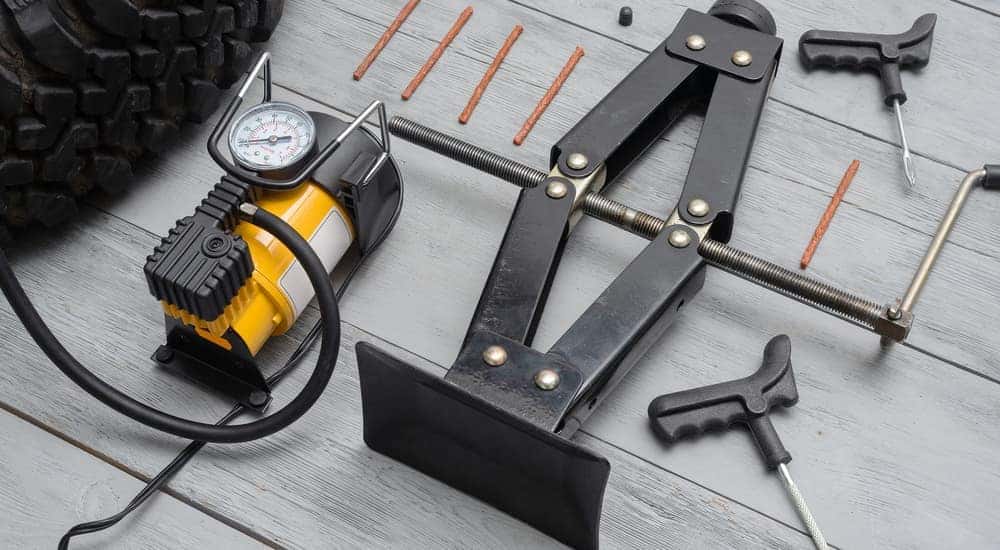
If you want to skip the above and repair your tire in a way similar to a service station (ensuring you may continue to drive on it as normal), you may use this method. Bear in mind this method is a bit more involved and has the potential to make the problem worse. First things first, you’ll need a tire repair kit. These do not come with cars but can be found at most big box stores in the automotive section. You will also need a jack and lug wrench to remove the tire, which you also may need to purchase ahead of time if your vehicle didn’t come with a spare tire.
Removing the flat tire is fairly simple. First, loosen the lug nuts – this may prove difficult, so don’t be afraid to stand on the wrench or even carefully jump on it to break the nut loose. Then jack up the corner of the car, being sure to place the jack on a firm surface under the reinforced jack point on the frame. Putting the jack in the wrong place can result in major damage to your car or injury to yourself, so be careful. After the car has been lifted off the ground, remove the lug nuts and the flat tire.
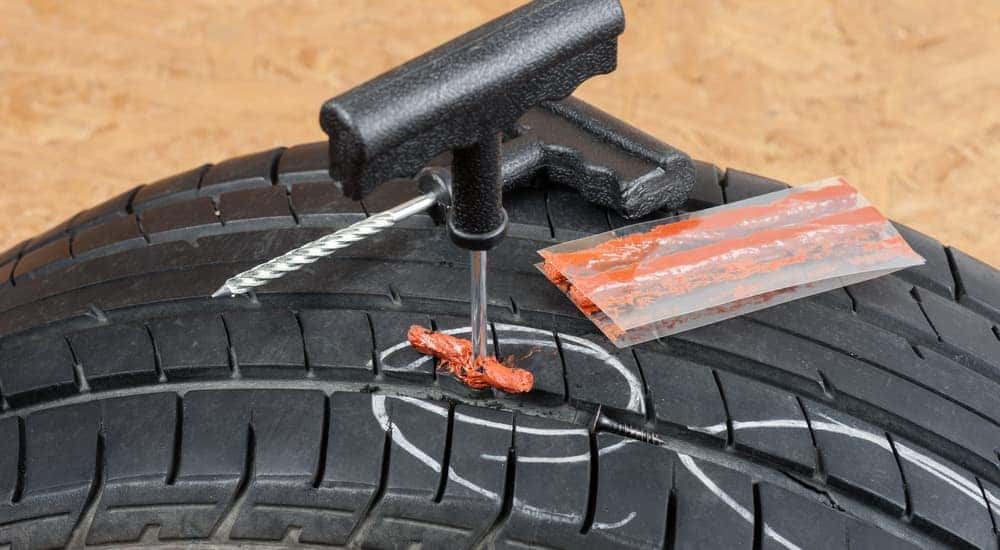
Make sure to put the lug nuts in a safe place and then inspect the tire to find the puncture. If there is anything stuck inside the tire, very carefully remove it with a pair of pliers. Use the honing tool from the kit to slowly clean and widen the hole. Do this by pressing the tool in and out of the hole, pressing in about halfway each time, and slowly twisting as you do so. Do this three or four times and set it aside. Next, peel one of the tar-covered strips from the kit and feed it halfway through the eye on the end of the other tool (similar to threading a needle).
Stand above the tire and press the sticky strip into the tire about halfway. In one smooth movement, twist the tool and pull up quickly. This will allow the tool to slip from the hole while the plug remains in place to do its job. Trim the excess with a knife or box cutter and use an air pump to re-inflate the tire to the proper level. Remount the tire to the car and hand tighten the lug nuts before lowering the car back to the ground. Then, using the lug wrench, tightening the lug nuts down in a star pattern, moving from across to the others in turn. This ensures the wheel is torqued properly.
4 – You Can Always Call Roadside Assistance
Sometimes it can be easier to call roadside service and let the professionals deal with it. After all, that’s what they are there for. If you don’t have experience dealing with a flat tire and are unsure what to do, it is usually a better idea to call for help than to risk damaging your vehicle or injuring yourself. Even if you know what you are doing, there’s no shame in admitting defeat. Sometimes the damage is too much to handle without a full shop, and sometimes you can’t find a safe or comfortable place to deal with a flat. AAA or another roadside assistance service is an indispensable part of any tool kit.
You Have Options
Getting a flat tire is just a hazard of driving and will be experienced at some point. The days of always having a spare tire are long gone, with most manufacturers opting to save weight by giving drivers a tire repair kit. It is highly recommended that you carry a toolbox in your car with basic tools. If your car doesn’t have a lug wrench, get one, as you never know when it will come in handy. As the old adage says, it’s always better to be prepared. Happy motoring!

0 comment(s) so far on 4 Tips to Fix a Flat Without a Spare