



No Contest: 2016 Chevy Cruze vs. 2016 Honda Civic
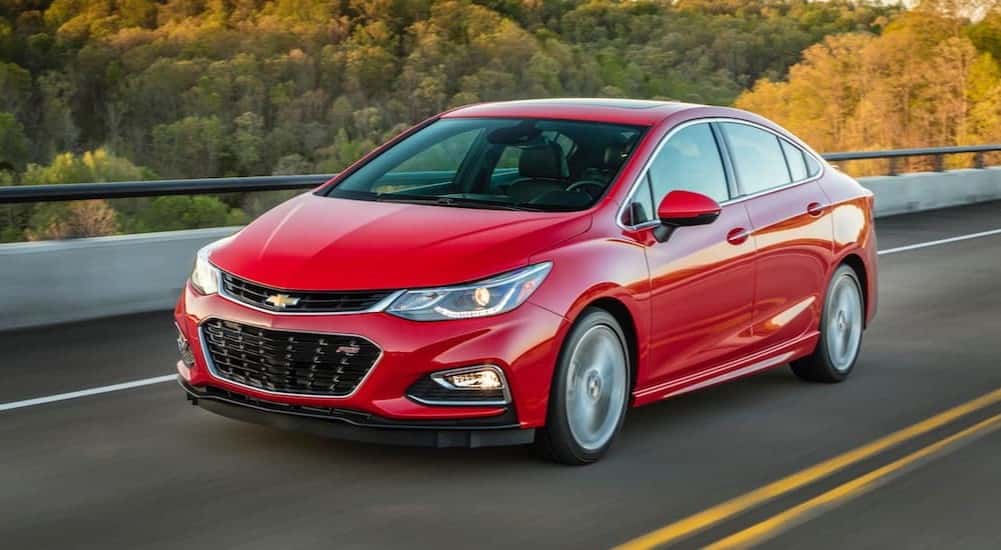
In a market that’s dominated by sedans, you’d figure compact cars like the 2016 Chevy Cruze would be struggling to fit in. But, the opposite is actually true. The Cruze is now Chevy’s second best selling model, the first being the Silverado, and it’s putting the Malibu and Impala to shame. The Cruze is particularly popular among younger drivers, so it’s no surprise it’s doing so well. But, how is the Cruze holding up against the rest of the competition? Compared to the Mailbu and Impala, we know it’s holding up just fine. But what about a sedan that has been around since what seems like the dawn of time? The Honda Civic just experienced a 2016 release as well, and is another popular sedan among younger drivers.
What matters most with a sedan, especially with the younger generation, is the design, technology, fuel economy and price. Therefore, let’s explore each category and see which sedan does it better.
Design
The younger generation doesn’t want a vehicle that looks like it just crawled out of a tear in the time-space continuum; they are looking for a vehicle that has a modern and hip design. Both models fit this criteria, and both have experienced redesigns, but which one is wearing their makeover better?
Cruze
The Cruze’s 2016 redesign is an eye-catching one. It has more flash, and a much stronger athletic presence than the last model. The whole design is aerodynamically sculpted to create a noticeably sportier appearance, and also helps with the overall efficiency of the vehicle. No matter where you go, you are bound to be the center of attention in the Cruze — and leave a lasting impression.
The design all starts with Chevy’s elegant and subtle split-grille, which makes the bold design of the rest of the front-end pop. The headlights match the windswept design of the front-end and hood, and it wears LED daytime running lights like jewelry on the higher trim levels. These LED daytime running lights are also accompanied by projector-beam headlamps that add a whole new level of definition to this car.
The rest of the Cruze is aerodynamically cut and chiseled, and is very satisfying to look at because for once it doesn’t feel like there is something missing. The whole package is there.
Civic
The Civic design is…interesting. It’s outlandish, looking more like a space ship than a car.
For example, one of the first things I noticed was the shape of the tail lights. They stick out strangely away from the back of the vehicle and appear to run up onto the spoiler. This creates an angular C shape that is an awkward eye sore on what seems to be a decent design otherwise, even if it is a little bland in the front.
The grille and headlights look like they are worked into the front-end of the vehicle, and it’s hard to tell where one stops and another begins. This causes the front of the vehicle to have a focal point, and because of that, it has much less definition than the Cruze.
The hood is rather flat and bland, and it doesn’t have nearly as much as athleticism as the Cruze. Dropping the rotten cherry on top, the roof of the Civic looks like it tapers off to meet the trunk too quickly. The result? A vehicle that is somehow both bland and outlandish, and awkwardly designed.
Technology
As far as technology goes, the 2016 Chevy Cruze is sporting state-of-the-art advancements. The two most notable are Chevy MyLink and 4G LTE Wi-Fi.
Chevy MyLink is the system that the seven-inch diagonal color-touch screen runs on. It can do everything and anything, thanks to BlueTooth compatibility. The latest MyLink system can work with your phone to provide hands-free calls, voice texting, play music, and even use navigation. Best part is, Chevy recently introduced Apple CarPlay to the MyLink system. That means both Apple and Android users will be able to experience the advanced phone integration offered by MyLink.
Also, your phone won’t run out of data using it, because the Cruze is the first car in it’s class to offer an available built in 4G LTE Wi-Fi hotspot that works with OnStar and your phone. This ensures that no matter where you go, you will be able to access your apps when and where you want.
The Cruze also offers some other great technological perks, like push-button start, wireless charging for your gadgets, and a premium nine-speaker Bose sound system.
Civic
The Honda Civic has something called HondaLink, which has the same function as Chevy’s MyLink: Apple CarPlay, Android Auto, hands-free capability, etc. The display is also a seven-inch touch-screen and functions the same way as the Cruze’s.
What’s missing from HondaLink? A Wi-Fi hotspot. The Civic doesn’t have a Wi-Fi hotspot on board like the Cruze does, which hinders the use of your smart phone. To the older people reading this, that may seem like a petty difference. But, to a younger person who’s smart phone-oriented? That’s a game changer.
Other than the HondaLink, it appears the Civic doesn’t have anything different than the Cruze. But, that one-up the Cruze gets from having Wi-Fi on board would make a huge difference if the two vehicles were for sale side-by-side.
Fuel Economy
A major factor for everyone, not just the younger generation, is the fuel economy a vehicle gets. Since these are both sedans, it’s not surprising the fuel-economy race is neck and neck.
It all starts with the engine, and the Cruze has one that delivers exceptional fuel economy with a spirited kick. The 1.4-liter inline four-cylinder engine puts out 153 horsepower and 177 lb-ft of torque. Not bad for a compact sedan, especially considering it returns 29 mpg city and 41 mpg highway.
The Honda Civic also comes with a single inline four-cylinder engine that puts out 158 horsepower and 174 lb-ft torque. As you can see, the difference between the two engines is a negligible one, just like the fuel economy. The Honda Civic gets 31 mpg city and 42 mpg highway at most, fluctuating between trim levels.
Unlike the design and technology, this is one category where a clear winner can’t be determined. They are so close in fuel savings and power, it’s barely even a contest.
Price
A massive difference, however, is the price. The 2016 Chevy Cruze has a starting MSRP of $16,620, and the Honda Civic has a starting MSRP of $18,640. The overall price of the Cruze really shines, and is what makes this competition a no-contest scenario. For $2,000 less, the Cruze is able to do everything the Honda Civic can do – some of it even better, like the design, for example. What does over $2,000 get you if you opt for the Honda Civic? Some weird looking tail lights and one more mpg.
Whether the Cruze is a compact sedan or not doesn’t matter, because in this market it’s still a sedan. It’s still a car that attracts younger drivers and that puts it in direct competition with the Honda Civic. Even if you aren’t convinced by this article, the fact that Cruze sales have kept climbing since it was first released should be an indication of this vehicle’s success. No doubt this is because of the Cruze’s sporty design, modern technology, stellar fuel economy, and low price.

0 comment(s) so far on No Contest: 2016 Chevy Cruze vs. 2016 Honda Civic