



Signature Design Cues Connect 60 Years of Corvettes
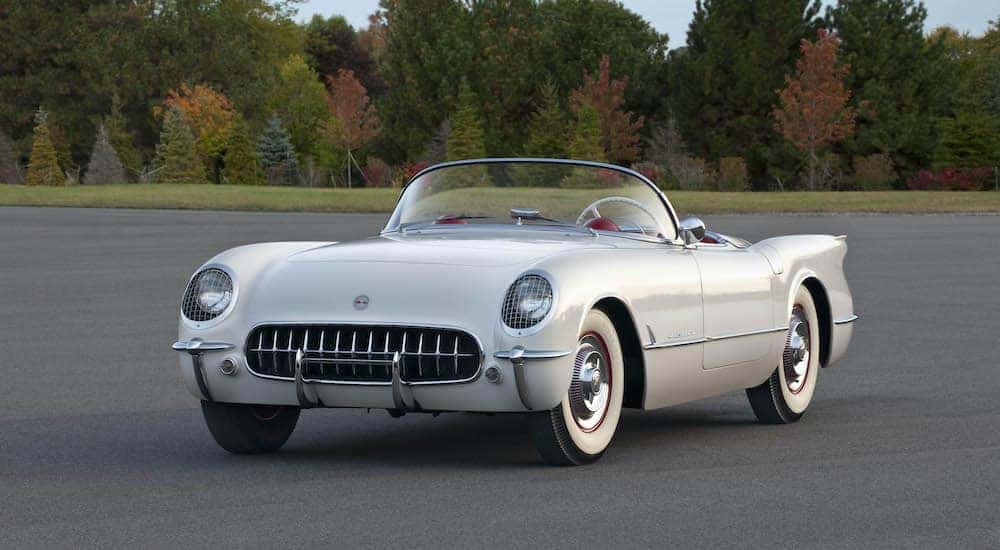
The Chevrolet Corvette has been an icon to car lovers for its sleek lines and high performance for six decades. To celebrate this major milestone, Chevrolet is rolling out something very special. Let us here at McCluskey Chevrolet, your home of the Chevrolet Cruze, tell you about it.
The first Chevrolet Corvette, the XP-122 Motorama concept car, and the latest model, the 2013 Corvette 427 Collector Edition convertible, are separated by 60 years of automotive development and advancement. They do not share a single common component, yet the visual connection between the first and sixth generations is obvious. This is part of what makes the Corvette such a legendary vehicle – the ability to remain recognizable and distinct even throughout decades of innovation and development. While the design cues have changed through six generations, it’s their elemental composition that makes a Corvette look like a Corvette. “For our Cincinnati Ohio Chevy Corvette drivers and enthusiasts the Corvette’s design represents a distinctive American high-performance sports car,” said Keith McCluskey of McCluskey Chevrolet. “No matter the year, the Corvette is instantly recognizable to any driver.”
What Elements Set the Corvette Apart
Without looking at it, or ever seeing one before, if you simply read a basic class description for the Chevy Corvette, you might easily assume it looks just like any other sports car. Many other sports cars are available as both coupes and convertibles, and they’re all designed to be aerodynamic and have a strong stance on the road. The reason so many people have been dedicated Corvette fans for decades, however, is that it truly has a unique design that sets it apart in the auto industry. Once you see a Corvette or Stingray, there’s no mistaking it for anything else on the road.
Here are a few of the common elements that have helped make each design unique up to 2013:
- Proportion: Each Corvette has similar proportions – from the long “dash to axle” element, to the short tail and small greenhouse.
- Waterfall effect: A powerful, signature cue common among all Corvette generations is the way a part of the exterior bodywork cascades into the passenger compartment between the seat backs, introduced on the first-generation Corvette convertibles. Since then, the waterfall effect has been reinterpreted to make a seamless transition from the exterior to the interior of Corvette.
- Dual cockpit architecture: Another iconic Corvette design cue that was inspired by jet fighters is the dual, wraparound cockpit. Introduced when Americans were obsessed with space flight, the wraparound cockpit instantly conveyed purposeful performance. Today, the Corvette’s interior still conveys the car’s sporting intentions, with easy access and visibility of the critical controls.
- The bodyside cove: While a spear-like chrome feature highlighted the side of the 1953-55 Corvettes, for 1956, a concave cove was sculpted into the bodywork behind the front wheels. Although its form and function have been reinterpreted over the years, a cove or vent has been a signature cue in the Corvette’s body side ever since.
- The tail:Another Corvette signature is the design treatment of the car’s tail. Peters notes that it’s not just the use (since 1961) of twinned and rounded tail lamps at either side of the back of the car. Instead, it’s how the relationship between those lamps, exhaust pipes, and event license plate opening compliment the low, wide proportions of the Corvette body.
For those who have loved the Corvette for decades, 2013’s model is sure to excite car enthusiasts for many years to come. This automotive classic is celebrating 60 years with style and we can’t wait to see what comes next. It could be something truly innovative…
2021 Update
Hello there, friends and customers, and welcome to a well-deserved update regarding the look and design of the Chevy Corvette. We wrote that original piece all the way back in October of 2012 with the 2013 model making waves and establishing itself as a gorgeous addition to the Corvette legacy. Little did we know that in less than a decade, the entire look of the Corvette would change radically with the introduction of the incredible, mid-engine C8 model.
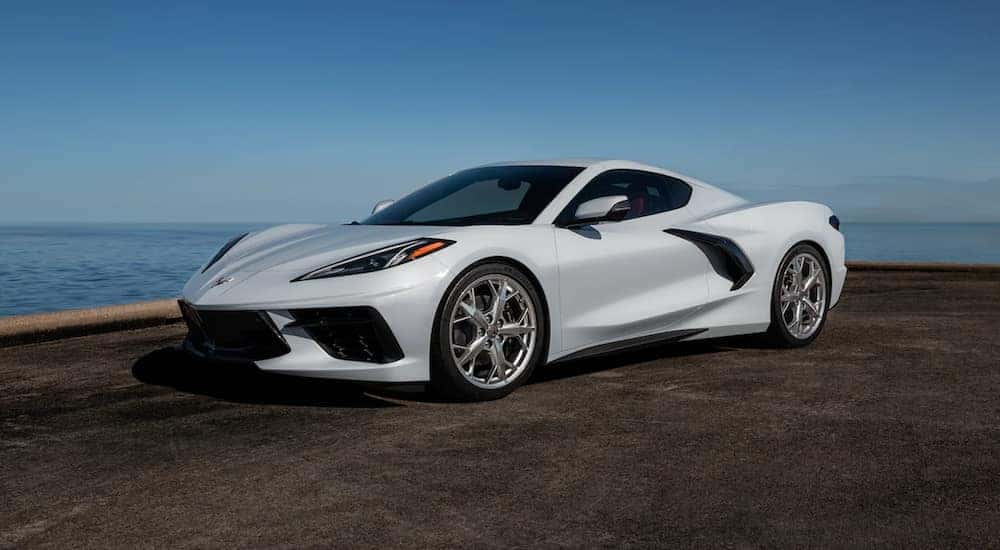
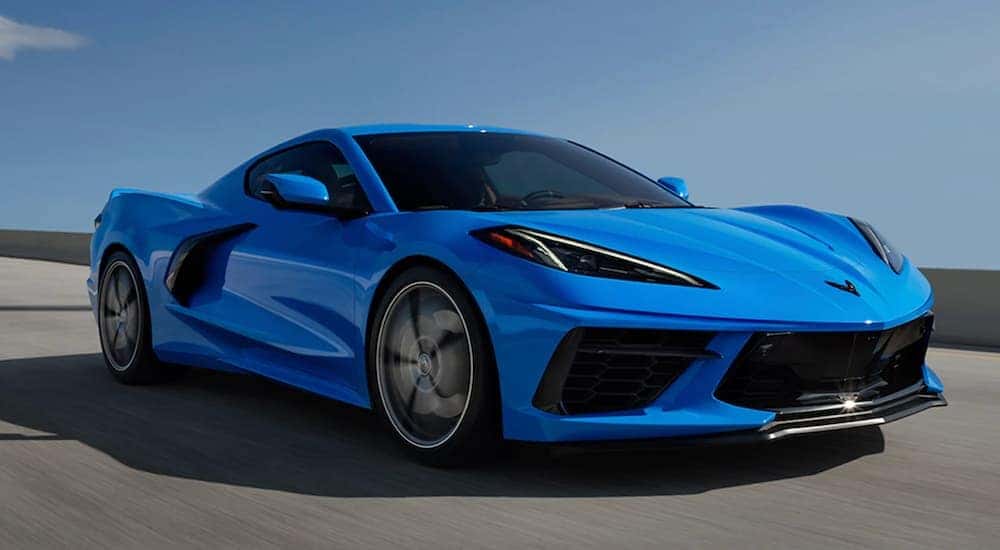
One of the things we absolutely love about the C8 – the mid-engine Corvette – is that even though its design was completely updated with numerous changes, it’s still unmistakably a Corvette. You can’t check out the latest model and think you’re looking at a Mustang, a Toyota sports car, or some new Dodge vehicle. Even though there have been some major changes to accommodate the innovative new design of the mid-engine Corvette, one look is all it takes to see that this is still everything we’ve come to expect and love from Chevy.
The Mid-Engine Design
Before we get into how the exterior design and aesthetic of the Corvette have changed and been updated, we have to talk about why this happened. Sometimes, in the auto industry, there’s a push to do new or different things simply for the sake of them being new or different. There’s a desire to stand out among the crowd, and so you’ll sometimes see big changes in an effort to do that without anything real or meaningful behind them.
With the latest C8 generation for the Corvette, however, that couldn’t be further from the case – the major changes and overhaul all serve a single purpose: the mid-engine design. The engineers and developers at GM working on the Corvette had hit a wall – they had made the Corvette as good as it could be with a classic, front-engine design. While they could boost horsepower, improve its stance, and make some other minor changes, there was only so much that could be done with its conventional design.
The solution to this problem was simple (and something a lot of us had been hoping to see for decades): a mid-engine design. By moving the engine back in the vehicle to just behind the cockpit and right over the rear wheels, the weight distribution for the entire car changed. This opened up tremendous potential for performance and new design choices based around a sports car with a much better center of gravity. Such a revolutionary step had, as you’d expect, a number of effects on the exterior and overall look of the Corvette.
Changes in the Look
For a lot of people, the most obvious change to the C8 Corvette is that the nose is now much shorter than ever before. In the past, the front-end of the Corvette was pretty long and had the signature “Stingray” design and shape to it. Now that the engine is toward the back of the car, the front-end has been shortened significantly. It still retains its swooping shape, but there’s no denying that it has much more of a snub nose to it.
That being said, many of the features we looked at before are still here, just altered and reworked for this new generation of Chevy performance. With the engine behind the cabin, the tail of the C8 Corvette is longer than before, and the overall proportions have shifted, but the shapes and design cues are all still there. You see the rear of the C8, and it still looks like a Corvette, still delivers a feeling of raw power and incredible performance.
The bodyside cove is still in full effect – in fact, it’s been made even more pronounced and serves a real function as an air intake for the engine. This is the perfect example of how the traditional design of the Corvette has been kept and improved upon for the C8. You can see these kinds of decisions all throughout the design of the latest generation for the Corvette. It’s clear that the folks at GM know people wanted the all-new C8 to still look and feel like a Corvette while offering an experience, unlike anything that’s come before.
Similarly, the wraparound cockpit is better than ever and designed to surround the driver with everything you need while on the road. Traditional dashboard controls were moved onto a new row of buttons between the driver and front-passenger, putting everything you need at your fingertips around you. Best of all, the shorter nose provides a better view of the road, which Chevy’s designers embraced by lowering the dash to give you a truly unobstructed view as you fly along the highway.
More Innovation in the Future
This new C8 generation is not simply a strange experiment or one-off design – this is the future of the Corvette. Although details on what’s to come are still pretty scarce, from what we’re hearing, the engineers and designers at GM are running with this latest design. There are two more models on the way that will take performance to the next level: a powerful Z06 with a more powerful engine and a turbocharged ZR1.
As part of GM’s commitment to leaving the internal combustion engine behind, we’re going to see a slew of alternative-energy models for the Corvette. So far, it looks like we’ll get a hybrid and a plug-in hybrid model in the not-too-distant future, which will carry the C8 forward. Beyond that, there’s word that an all-electric Corvette – affectionately dubbed the “e-Ray” – is on the horizon and will usher in a new era for Corvette performance and power.
If you still prefer the conventional engine, then you’re in luck there, too, as sources inside GM have stated that work continues on a Corvette Zora model. This will likely use a hybrid engine to boost power and achieve 1,000hp or even more, turning the incredible C8 into a truly next-level hypercar. This and the e-Ray are probably a few years away still, but in both cases, the mid-engine design (or battery packs for the e-Ray) and everything it offers seems to remain.
What do You Want in a Corvette?
As you can see, we’re passionate about the modern Corvette and the way that Chevy’s designers and engineers managed to retain what we love about the classic design while offering unprecedented upgrades. As we look to the future, toward the 70th Anniversary that’s just around the corner, we can’t wait to see what Chevy has to offer and how they’ll continue to innovate. But what about you? What do you want from the Corvettes yet-to-come, and what elements should return or change in the years ahead? Call or come visit us at McCluskey Chevrolet to talk about the mid-engine Corvette and everything it has to offer; we’d love to hear from you.

0 comment(s) so far on Signature Design Cues Connect 60 Years of Corvettes