



Subcompact Showdown: 2024 Chevy Trax vs 2024 Hyundai Venue
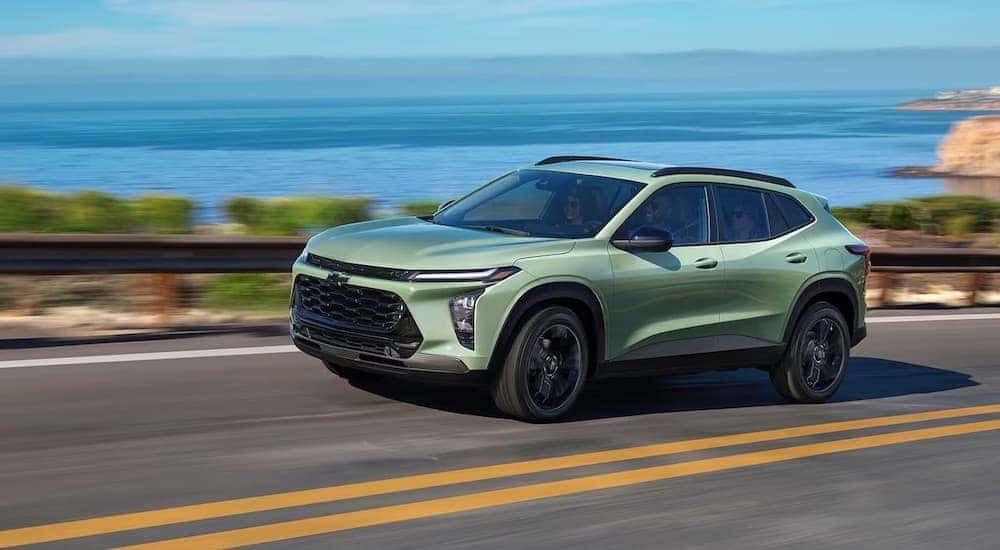
Subcompact SUVs offer a great fusion of efficiency and practicality. Their smaller size means they’re a little easier on your wallet when you hit the gas station, while their higher ride and increased cargo capacity offer some real advantages over your typical sedan. It’s no wonder this segment has exploded in popularity over the last few years, especially for drivers who focus on value when selecting their next ride. However, the segment’s growing reputation does present one challenge as drivers struggle to choose between all the different models on offer.
While there are some outstanding subcompact crossovers on the market, there are also plenty of duds, which is why it’s so important to do your research before investing in a vehicle. Take the 2024 Chevy Trax vs 2024 Hyundai Venue, for instance. These two SUVs embody everything there is to love about the crossover segment, but which one best represents those values that drivers have come to expect? We’ll answer that question as we take a closer look at the Trax and Venue and see how they stack up in terms of reliability, fuel economy, value, and passenger and cargo space.
Reliability
Lifetime maintenance and reliability costs can be difficult to measure when you’re talking about a late-model vehicle like the 2024 Trax and Venue. It’s still a little too early to know what sort of common issues might creep up over time, which is why looking at each manufacturer’s track record is so important. There are several ways to gauge overall reliability, but let’s start with one of the most common: problems per 100 Vehicles (PP100).
This is the metric used by J.D. Power, the automotive industry’s leading data analytics, software, and consumer intelligence company, and it can give shoppers a lot of insight when it comes to comparing different models. J.D. Power recently released its 2024 Vehicle Dependability Study (VDS), and the results should encourage any driver considering a new vehicle. The VDS ranked Chevy third in the mass market segment with 174 PP100, but the brand fares even better when compared with many of its domestic rivals. Jeep (190), GMC (206), and Ford (239) all trail Chevy by a considerable margin, which can make a lot of difference over the life of a vehicle.
Where does Hyundai rank in the VDS? The South Korean automaker has overcome a reputation for lackluster workmanship in recent years, finishing with a 198 PP100 score that places it right towards the middle of the pack. The company offers a pretty generous ten-year/100,000-mile powertrain warranty on all its vehicles, but such a comprehensive plan is almost required when your overall reliability struggles to break the industry average. Chevy offers a five-year/60,000-mile powertrain warranty on the Trax, though the crossover does come with one perk that drivers are sure to appreciate. Drivers can return to our dealership during the first year of ownership for a free scheduled maintenance visit, which can prove invaluable when it comes to heading off problems or spotting abnormal wear and tear.
Passenger and Cargo Space
Drivers might not flock to the subcompact crossover segment with passenger and cargo space in mind, so it’s always a pleasant surprise when a vehicle exceeds expectations. That’s certainly the case with the 2024 Chevy Trax, which is now bigger than ever, thanks to a recent second-generation refresh. Chevy stretched the crossover’s wheelbase by half a foot, which makes a noticeable difference when you climb into the cabin.
It’s roomier than ever before, increasing not only cargo capacity but also legroom in a change that should make backseat passengers just a little more comfortable. The Trax now offers 25.6 cu.ft. of cargo capacity, but folding down the second-row seat sees that number increase to a spacious 54.1 cu.ft. That should be more than enough room to tote all your groceries, sports equipment, luggage, or whatever else you might need to bring along for the ride, making the Trax an effective and efficient choice for even the busiest family.
The Hyundai Venue offers a somewhat more cramped experience than the Trax. That’s to be expected given the fact that the Venue’s wheelbase is a full seven inches shorter than the Trax, which logically translates into less passenger and cargo room. At 110.6 cu.ft., the Venue’s total interior volume is a bit lacking when measured up against the Trax’s 125.4 cu.ft. It’s a notable gulf and one that should be carefully considered for any drivers who expect to regularly be filling all five seats with passengers.
The Hyundai’s 18.7 cu.ft. of cargo capacity is another area of concern as it’s some seven cu.ft. less than that of Chevy’s subcompact. That number does increase to 31.9 cu.ft. with the second row stowed away, but that’s still more than 20 cu.ft. behind the Trax. These numbers might be hard to put into context until you’ve climbed into the cabin, but they suggest that the Venue is in dire need of the same wheelbase-extending refresh that the Trax was treated to for the 2024 model year.

Fuel Economy
The 2024 Chevy Trax earns an EPA-estimated 28 MPG in the city and 32 MPG on the highway. These impressive numbers are made possible thanks to the crossover’s ultra-efficient 1.2-liter turbocharged inline-three engine. Pair this sort of power with a six-speed automatic transmission and front-wheel drive, and you’ve got a subcompact that can go toe-to-toe with any other model in its class when it comes to fuel economy. The Trax also manages to pull off this feat without feeling underpowered. The SUV’s 8.8-second zero to 60 mph time isn’t going to win you many races, but the 137 hp engine provides enough get-up-and-go to give drivers plenty of confidence when traveling at highway speeds.
How do these numbers compare to the Hyundai Venue? The two subcompacts are pretty well-matched when it comes to fuel economy, but that’s not the only difference between these two models. The 2024 Venue offers an EPA-estimated 29 MPG in the city and 33 MPG on the highway, but this single MPG difference might be pretty difficult to notice under normal operating conditions. One thing drivers probably will notice is the Venue’s comparative lack of power.
The Hyundai boasts an extra cylinder over the Trax with a 1.6-liter, four-cylinder setup, but it somehow manages to return less power, with 121 hp. The Venue is also designed with a continuously variable transmission (CVT) that doesn’t help the model’s performance resume, especially when you weigh it against the Chevy’s traditional transmission setup.
Value
Value means different things to different drivers, with some prioritizing performance and convenience and others focusing on factors like reliability and fuel economy. No matter how you define this particular metric, one thing is for sure: the 2024 Trax’s $20,400 starting price is hard to beat in a crossover segment where the average starting price hovers closer to $30,000.[a]
The Trax’s base LS trim offers a considerable list of standard features. These are largely focused on the technology and convenience side of the equation, with the Chevy coming standard with an eight-inch touchscreen infotainment display, remote keyless entry, and wireless smartphone connectivity. The LS is also offered with an impressive list of advanced driver assistance systems (ADAS) like Automatic Emergency Braking, Front Pedestrian Braking, and Lane Keep Assist with Lane Departure Warning, with only Adaptive Cruise Control being reserved for the higher trims.
The Venue’s entry-level SE trim is priced within a couple hundred bucks of the Trax, but its value starts to suffer as you climb through the trims. The SE offers decent value for the price, but those spending over $23,000 for the Limited trim might be a little put off by the fact that it retains the same eight-inch infotainment display as the cheaper versions. This is especially hard to swallow when compared to the Trax, which ups the display to 11 inches on the LT trim and up, not to mention adding an additional eight-inch digital gauge cluster.
The 2024 Venue’s safety features are in the same ballpark as those found on the Trax with standard Forward Collision-Avoidance Assist with Pedestrian Detection and Lane Keeping Assist, but the subcompact did post a worrying four-star overall safety rating from the National Highway Traffic Safety Administration (NHTSA). The 2024 Trax has yet to be reviewed by the NHTSA, but it’s worth noting that the 2022 model did score a perfect five stars.

Practical, Reliable, and Packed With Value
If you’re in the market for a practical, reliable crossover that’s packed with value, it’s hard to beat the 2024 Chevy Trax. The subcompact’s low starting price is the obvious headline, but the deeper you dig, the more there is to love. The Trax is not only a standout when it comes to efficiency, passenger space, and cargo room, but it’s also produced by one of the industry’s most reliable brands. The Hyundai Venue is not a bad example of the popular crossover trend, but it simply can’t keep pace with Trax in some key areas. The SUV’s lackluster performance is one particular concern, not to mention Hyundai’s middling reputation for reliability. The team at McCluskey Chevrolet is here to walk you through everything there is to love about Trax, from its modern style and responsive handling to its jam-packed trophy cabinet that includes both a 10Best and Editors’ Choice award from Car and Driver.

0 comment(s) so far on Subcompact Showdown: 2024 Chevy Trax vs 2024 Hyundai Venue