



Big and Bigger: The Chevy Tahoe vs The Chevy Suburban

If you’re at a stage of life where you value space and utility, your next vehicle will likely be a large SUV, like the Tahoe or the Suburban. Both offer expansive cabin space for passengers and cargo, as well as the options you need to keep everyone entertained while running around town on a busy weekday. With new Tahoes and Suburbans topping off in the $70,000 range, you might be thinking it’s an excellent time to head to a Cincinnati used car dealership and take a look at pre-owned inventory.
Many busy families want the size advantage of a Tahoe or Suburban but simply can’t justify the high price tag of buying new. Looking at a slightly used vehicle is the best way to carve out that extra 20-30% of value and keep the price under control. Even better, you still end up with a great SUV, and in some cases, you’ll still be able to take advantage of the factory warranty if something goes wrong.
Knowing a pre-owned option exists is the first hurdle. Next, you’ll have to decide whether a Chevy Tahoe or a Chevy Suburban works best for you. So, what’s the difference between these two large full-size SUVs? Each model caters to a specific buyer with model-specific differences that are significant. It’s important to drill down to the nitty-gritty details when comparing these two SUVs because they may seem very similar on the surface.
Some key areas of focus include available trims and packages, price, and overall size. We also think it makes sense to look at where these two SUVs overlap. Once you know the differences, you can choose the best SUV for you and your family. The good news is, you can’t go wrong!
Tahoe vs Suburban: Similarities
The Chevy Tahoe and the Chevy Suburban share the same platform, which means they ride on the same chassis and benefit from the same engineering and design concepts. The sharing of platforms is common with auto manufacturers in order to create economies of scale across multiple nameplates. It’s not uncommon for SUVs to share the same platform as a pickup truck, and with automakers that have a luxury brand in their portfolio, platforms can show up under multiple nameplates.
On the interior, both SUVs have a max seating capacity of eight passengers; however, if captain’s chairs are selected for the second row, that number reduces to seven. Be sure to double-check seating configurations as you’re searching for used inventory because many buyers like to max out seating capacity. In contrast, others want the added luxury of more comfortable captain’s chairs in the back.
Another commonality is the factory warranty. These are both Chevrolet vehicles, which means they’ll enjoy a 3-year/36,000-mile bumper-to-bumper and a 5-year/60,000-mile powertrain warranty. If you buy a newer pre-owned Tahoe or Suburban, you may be lucky enough to tap into that three-year bumper-to-bumper warranty. If not, another way to get a bumper-to-bumper warranty is to consider a Certified Pre-Owned Suburban or Tahoe. These are vehicles subjected to a 171-point inspection that meets certain criteria set forth by Chevrolet’s GM Certified program. Every CPO Chevy comes with a 12-month/12,000-mile bumper-to-bumper warranty, among other great benefits.
Tahoe vs Suburban: Size
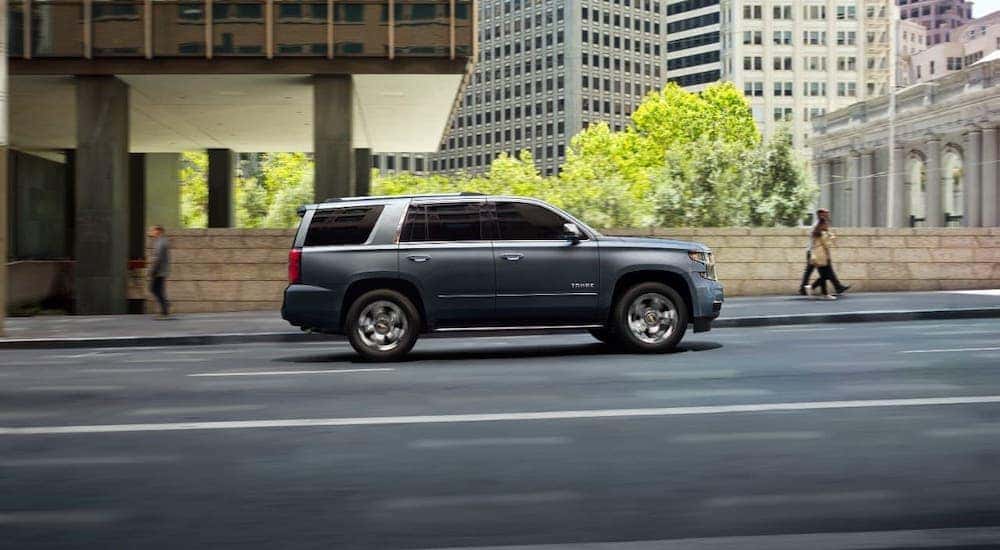
If you’re looking for the biggest full-size SUV, the Suburban is going to win that battle. A used Suburban is a whopping 20-inches longer than the Tahoe, and much of that space is devoted to the vehicle’s interior. This means more passenger and cargo room in the Suburban. The Tahoe offers about 95 cubic feet of cargo space with the second and third-row seats folded down versus the Suburban, which offers significantly more, at about 122 cubic feet. With all of the seats raised, the Tahoe offers around 15 cubic feet of storage, and the Suburban bests that capacity significantly, offering up to 39 cubic feet.
The Suburban’s exterior space translates into more room for passengers, too. That’s because its longer wheelbase (space between the front and rear tires) contributes to a smoother overall ride for passengers. The Suburban offers a third-row legroom space measurement of 34.5-inches. The Tahoe? Just 24.8-inches. That is a significant difference, so if you regularly transport more than five passengers, you might want to look more closely at the Suburban.
The bottom line on size is that both SUVs are very large; in fact, they’re among the largest SUVs you’ll find on the market today. Even with that, the Suburban is the bigger option. When comparing on the basis of size alone, you’ll want to consider interior space, both for cargo and passengers – particularly third-row passengers. If you need a lot of space, the Suburban is for you. If you only need to transport the max amount of passengers occasionally, opt for the Tahoe.
Tahoe vs Suburban: Capability
With the exact same powertrain options available on both vehicles, it’s surprising that the Tahoe inches ahead in max towing capacity, which we think is due to its size. The Tahoe’s max towing capacity is 8,600 lbs, while the Suburban maxes out at 8,300 lbs. It’s a relatively minor difference, but if you have something specific, you’re buying the vehicle to tow, make sure you keep this difference in mind. Keep in mind that towing capacity can fluctuate between model years, trims, and engines, so always check what the capacity of the specific vehicle you are looking at is.
Size is an advantage for the Tahoe when we look more closely at performance. The Tahoe delivers a 0-60 time of 5.9 seconds, while the Suburban is noticeably slower, at 7.1 seconds. Where this really matters is when you’re taking road trips and during normal driving conditions, such as when you’re accelerating on and off the highway. Again, these differences are fairly minimal, but some buyers place more importance on performance, so this detail may be a deal-breaker for you.
Another small difference you will find between these two SUVs is in their fuel economy ratings. Both get similar fuel economy ratings, which again can fluctuate between years and models. You can expect around 18 MPG combined for front-wheel drive models of either vehicle. A four-wheel drive Suburban will get around 16 MPG combined, while a four-wheel Tahoe will get about 17 MPG combined. Again, these are small differences, but still important to consider.
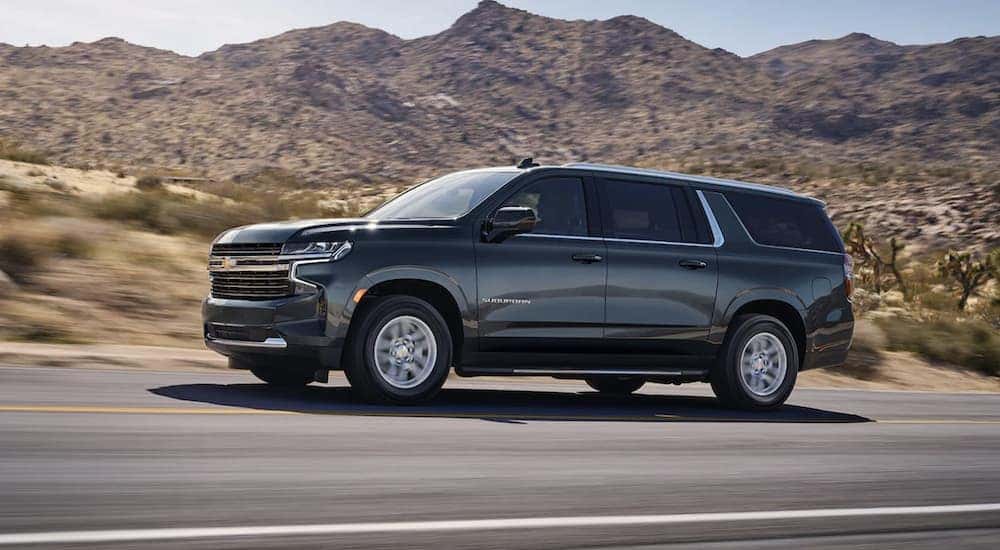
The 2021 Chevy Tahoe and 2021 Chevy Suburban
It’s been a few years since we took a good look at the Chevy Tahoe and the Suburban to see what each of them has to offer. In the auto industry, just a few years often feels like a lifetime as new generations and updated models can have significant changes to them. This is certainly the case with these two models since both of them were fully updated and redesigned for the 2021 model year, kicking off a new generation for these fantastic SUVs.
Thanks to these changes, the all-new 2021 models have some significant differences from the previous generation. First and foremost, they’re both bigger than ever before, not only measuring longer than the last generation, but with a new design that expands the interior even more. They also both have a number of fantastic standard driver assistance features, with additional options available to take your safety even further. Combine all of that with the most advanced available suspensions in their class, and you have two of the best SUVs on the market. Let’s take a look and see how much of a difference all of this really makes.
2021 Tahoe vs Suburban: Similarities
Believe it or not, when comparing the 2021 Chevy Tahoe and Suburban, they actually have more in common than their differences, so this is a great place to start. Both of these models have been expanded and redesigned to be larger, offering even more space inside than ever before. In addition to a longer overall size, both the Tahoe and the Suburban have had their wheelbases extended, and the interior floor dropped lower due to a new suspension, which allows them to have more passenger room inside, especially for people in the third row.
Speaking of the suspension, this is one of the biggest parts of the redesign of both of these vehicles. An independent rear suspension is now standard on both the Tahoe and the Suburban, which is part of the reason the floor could be dropped lower. Going even further, Chevy offers magnetic ride control on both models to ensure a smooth and incredibly comfortable ride for everyone inside. Most exciting of all, first-in-class four-corner Air Ride adaptive suspension is available for the Tahoe and the Suburban. This is one of the most impressive and comfortable suspensions on the market – having it available for these two large SUVs ensures you get a more stable and comfortable ride than ever before.
To keep things nice and simple, both the Chevy Tahoe and Suburban have the same trim levels available. The LS is the starting trim, followed by the LT and the RST for added luxury, then the Premier, and finally, the High Country takes sophistication and technology to the next level. If you’re interested in leaving the road behind, then the trail-focused Z71 trim is the one to consider. It features four-wheel drive standard, along with front skid plates, red frame-mounted recovery hooks, a heavy-duty air filter, and an Autotrac 2-speed transfer case for the best traction possible on and off the road.
Three engines are offered on both the Tahoe and the Suburban, starting with a 5.3L V8 that’s standard on both, which delivers 355 hp and 383 lb-ft of torque. Then there’s an available 6.2L V8 engine that offers 420 hp and 460 lb-ft of torque for added performance, as well as a 3.0L I-6 turbo diesel engine that delivers 277 hp and 460 lb-ft of torque. All three engines come paired with a 10-speed automatic transmission, so you get a quick and responsive experience with whichever one best meets your needs.
In terms of fuel economy, despite the differences in size, these two large SUVs are nearly identical. Consider the following numbers for estimated city/highway gas mileage:
5.3L V8 Engine:
- Tahoe (2WD): 16/20 MPG
- Suburban (2WD): 16/20 MPG
- Tahoe (4WD): 16/20 MPG
- Suburban (4WD): 15/20 MPG
6.2L V8 Engine:
- Tahoe (2WD):15/20 MPG
- Suburban (2WD): 15/19 MPG
- Tahoe (4WD): 14/19 MPG
- Suburban (4WD): 14/19 MPG
3.0L Diesel Engine:
- Tahoe (2WD): 21/28 MPG
- Suburban (2WD): 21/27 MPG
- Tahoe (4WD): 20/26 MPG
- Suburban (4WD): 20/26 MPG
As you can see, while there are some differences, they’re truly minuscule. It’s possible that you’ll experience some disparity between the two vehicles over many years of driving, but the numbers are so close that it’s just as likely that you’d get the same gas mileage from both models. In addition to this, the difference in towing capacity between them is less than ever before: the Tahoe can manage up to 8,400 lbs of maximum towing, while the Suburban tops out at 8,300 lbs of towing. Unless you’re going to use those 100 lbs of difference, you really won’t get more from the Tahoe than the Suburban can manage.
In terms of technology and other features, both models are also very similarly designed and appointed. Both the Tahoe and Suburban now have 10.2-inch infotainment displays standard, with 15-inch head-up displays available. When it comes to towing, you can get up to nine different camera views to get a fantastic view around your vehicle. Standard safety features on both models have also been updated, including an HD rear vision camera, automatic emergency braking, and a forward collision alert. Additional options like a rear camera mirror and HD surround vision, which gives you a virtual view of the area around your SUV, are available.
2021 Tahoe vs Suburban: Size
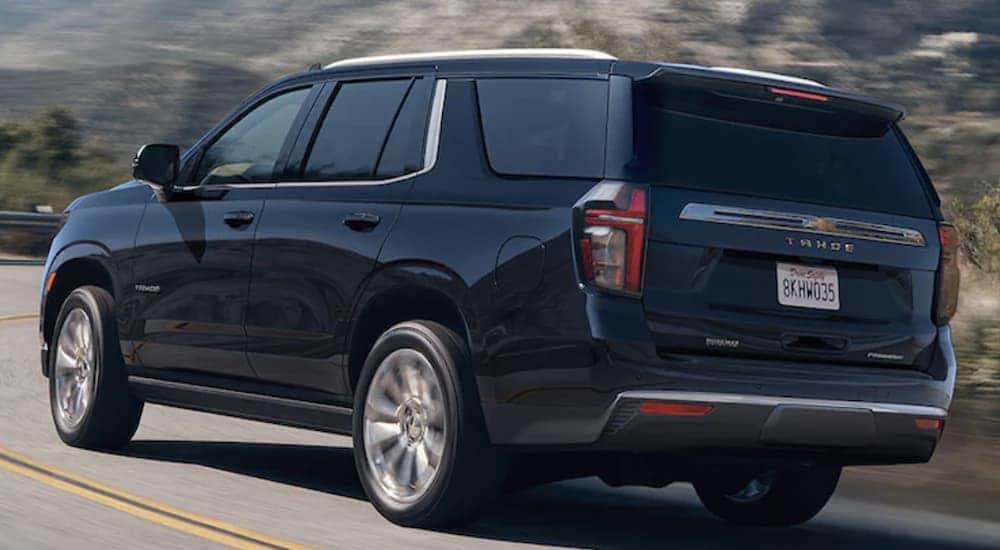
At this point, the most significant difference between the Chevy Tahoe and the Suburban really comes down to their size. While it might seem like they have so much in common that this probably doesn’t matter, in reality, the differences in size – inside and out – are pretty huge. Both of these vehicles are significantly larger than they were in the previous generation, which really lets you feel the power they command on the road.
The Tahoe measures 210.7 inches in total length, with a 120.9-inch wheelbase. It stands 75.8 inches tall and is 81 inches in total width. By comparison, the Chevy Suburban is now 225.7 inches long with a 134.1-inch wheelbase. The Suburban stands 75.7 inches tall and is 81.1 inches wide. You can see that in terms of width and height, these two models are nearly identical, and the length is what really sets them apart from each other, and that translates to significant differences in the interior space you can utilize.
2021 Tahoe vs Suburban: Interior Space
Inside these two vehicles, you get a tremendous amount of useable space that’s great not only for everything you need to take with you but also for your passengers. These are still nine-passenger vehicles, with seating for eight if you choose a different chair configuration, but either way, you get three rows of seats. To really get a sense of the difference in size between these two models, let’s take a look at how much legroom each of them has to offer.
Chevy Tahoe
Front Legroom: 44.5 in
Second Row: 42.0 in
Third Row: 34.9 in
Chevy Suburban
Front Legroom: 44.5 in
Second Row: 42.0 in
Third Row: 36.7 in
Surprised? Despite the fact the Chevy Suburban measures 15 inches longer than the Tahoe, they have identical maximum legroom for the front and second row. Even the third row, which is slightly different, has just a couple of inches more legroom in the Suburban. So where is all of that extra space, and why the difference in size? It comes down to cargo capacity within these two vehicles, especially the rear-area space. Here’s the cargo volume for these models.
Chevy Tahoe
Behind 3rd Row: 25.5 cu.ft.
Behind 2nd Row: 72.6 cu.ft.
Behind 1st Row: 122.9 cu.ft.
Chevy Suburban
Behind 3rd Row: 41.5 cu.ft.
Behind 2nd Row: 93.8 cu.ft.
Behind 1st Row: 144.7 cu.ft.
Here’s where you can see the massive difference in size really coming through – not only do both models have far more interior cargo space than the last generation, but the Suburban is much bigger. Remember that this is three-dimensional volume, so an extra 16 cu.ft. of rear space is absolutely huge and lets you store a lot more inside the Suburban. Looking back, the previous generation Suburban had up to 122 cu.ft. of interior cargo space, which is now matched by the Tahoe; that should give you some sense of just how much bigger they are than before.

Tahoe vs Suburban: Which One Is For You?
One thing to remember is that the Tahoe and the Suburban share the same potential demographic, which means they compete against each other for buyers. However, because they both share the Chevy name, your local dealer is going to remain completely unbiased! They’re not competing against another automaker for your business, so they’ll be in tune with your needs and keep the focus on determining the best fit.
The other benefit to the shared nameplate is that you won’t be traipsing all over town to look for a Suburban or a Tahoe. Your local Cincinnati area Chevy dealer has all the inventory you need, and if you don’t see the exact fit in their inventory, they’re in the best position to help you find the Tahoe or Suburban that ticks all the boxes on your list.
All-in-all, your decision is going to be based on size. Even pricing differences are minimal. The Tahoe is a little less expensive, but it is also a little smaller. Secondarily, you might want to consider towing capacity. Otherwise, these two full-size icons are going to deliver similar performance, comfort, and luxury options, as well as the same factory warranty and amazing dealer network for after-the-sale maintenance and repairs.
Nothing brings more peace-of-mind than knowing you can shop for your next Tahoe or Suburban at a single location, and you can trust that your local Chevy dealer will have the best Certified Pre-Owned and used inventory available for you to choose from. That, combined with excellent service and competitive pricing and financing options, make your task a little bit easier. So go out there and get your next Chevy Suburban or Chevy Tahoe today!

0 comment(s) so far on Big and Bigger: The Chevy Tahoe vs The Chevy Suburban