



How to Keep Your Used Car Going Strong Well-Past 100,000 Miles

Being a car owner can be a thrilling and fulfilling experience. From the road trips to the cruises around town, there is plenty of value in having a reliable form of transportation. That said, it takes more than filling up your car with gasoline to keep your form of transportation reliable. Here at McCluskey Chevy, we are home to a truly expansive selection of new and used cars in Columbus, Ohio, and while we certainly know how to sell them to our customers, we are also highly knowledgeable in how to maintain them. No car is designed to last forever, no matter how hard you try, however, you can keep your engine running just fine well past 100,000 miles with a healthy amount of regular maintenance.
Maintaining your car can be made easy too, with the help of a skilled team of auto technicians who have your best interest in mind, and you can find just that at McCluskey Chevy. In this post, we’ll dive into the details of how you can keep your new or used Chevy going smoothly for years and years to come.
What Happens to Your Car After 100,000 Miles
A lot can happen to your car over the course of 100,000 miles. From flat tires to oil changes, your engine, and all of the components that support it can experience any number of things over the many years it takes to get your odometer up to 100,000 miles. That said, there are certain components that tend to give out around this crucial time period.
One such component is your transmission. While every transmission is different, and there is no guarantee that this crucial part of your car will stop working, but many transmissions tend to have a lifespan of around 100,000 miles. Your transmission is possibly one of the most important pieces of your vehicle. Responsible for shifting gears and determining how much power is sent to the wheels, a broken transmission can stop your vehicle permanently. They’re also no easy task to fix or replace. Our mechanics at McCluskey Chevy have the experience necessary to go about fixing, maintaining, and even replacing transmissions.
Another component that might give out after 100,000 miles is your tires. While you should have changed your tires out already throughout those 100,000 miles, it is always wise to check the state of your tires once you’ve reached this crucial age for your vehicle. Your tires are more than just the wheels that provide you with momentum to press forward; they are your primary source of weight support and traction control.
While you may be able to ride on a set of tires that are bald and overinflated, it’s unlikely that your driving experience will be particularly pleasant. Here at McCluskey, we are equipped to change your used vehicle’s tires so that you can stay safe and on the road.
After 100,000 miles, it’s likely that your engine has been through quite a bit. No matter how timely you were with oil changes, residual oil grime is unavoidable. At this point, sludge has likely built up, resulting in a need for a change in motor oil. While you can continue using a standard grade of synthetic oil, the sludge will only continue to accumulate and can result in engine strain or worse.
There are many things that can happen to your vehicle while climbing its way to 100,000 miles, but if your engine is still running smoothly, and you’ve stayed on top of your regular recommended engine maintenance, you can easily drive your vehicle well past that 100,000-mile mark.
The Sludge Problem
What is motor oil used for? Well, it is a lubricant that engines use to reduce the level of friction caused between components. In any functioning gas-powered engine, these components are all moving, and were it not for motor oil; these components would suffer plenty of wear and tear and break far easier. Auto experts recommended that you swap out this essential lubricant once every 5,000 miles, however, the specific mileage can change from vehicle to vehicle and engine to engine.
So, what type of motor oil should you purchase once your car has exceeded 100,000 miles? If you haven’t already, you should request that your standard motor oil be changed out for high-mileage motor oil. High mileage motor oil is designed to tackle gunk and grime far better than basic alternatives. In the same instance, high-mileage motor oil does an excellent job of reducing the amount of smog output by your engine, which can be a serious issue for an engine that is well over 100,000 miles.
Just because your car has reached 100,000 miles doesn’t mean that you can’t still expect a fantastic driving experience, especially when you’re behind the wheel of a Chevy brand vehicle. Exchanging standard motor oil for high-mileage motor oil is just one thing you can do to improve your driving experience when your vehicle has reached that high-mileage mark.
Repairing Your Foundations
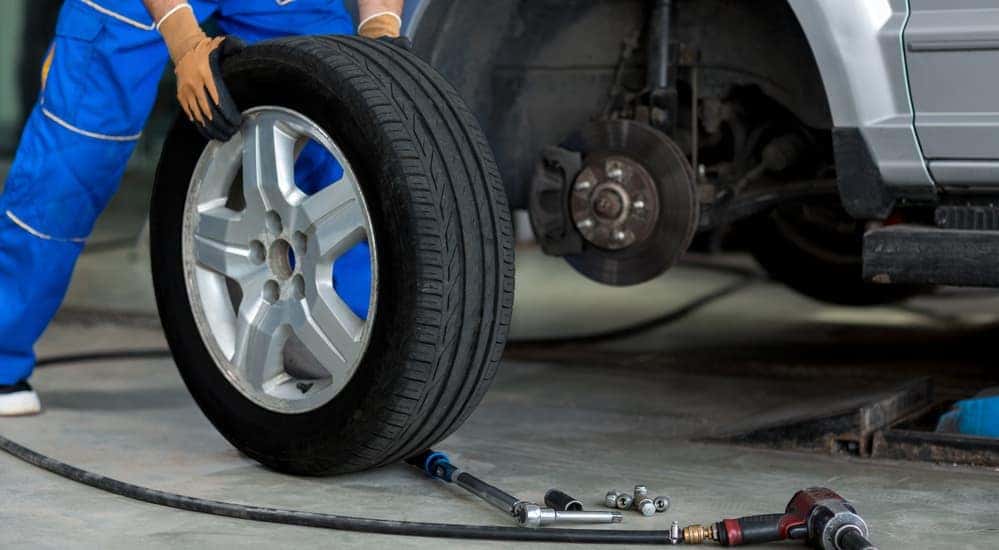
Your tires are the base of your vehicle, and as such, should be treated as essential as clean motor oil or a functioning transmission. On average tires last anywhere between three to four years; however, this average lifespan can vary depending on how you drive, air pressure levels, your alignment, and if you get regular tire rotations. While you can extend the life of your tires through proper tire care our auto experts recommend that you change out your tires when they’ve outlived their usefulness.
When do you know if its time to replace your tires? Well, one of the biggest tells is the tread depth. Tread is the series of grooves that run along the surface of your tire. These crisscrossing lines are essential for traction and help keep all four wheels securely on the road. Over time and thousands of miles, these grooves become shallower and shallower. If never replaced, these grooves can wear down to nothing, essentially becoming a ‘bald-tire.’ Bald tires struggle to gain traction and have a greater chance of bursting unexpectedly than a typical brand new tire.
So, if you’ve reached the 100,000-mile mark, you’ll want to have your tires thoroughly inspected from a trained auto parts professional. Even if relatively new, different tires can wear at differing rates, and having a healthy set can make all the difference in your driving experience.
Staying On Top of Your Transmission
Last but far from least on our list is your transmission. While expensive to repair and even more so to replace, your transmission can well outlive its 100,000-mile life expectancy. Prolonging the life of your transmission is fairly simple. All you have to do is have this essential component inspected and flushed on a regular basis. Having a professional check on your transmission regularly can help you catch serious mechanical issues that would have otherwise gone undetected. Changing out your transmission fluid can serve to extend the life of your transmission as well, ensuring that this component continues to function at optimal levels far beyond 100,000 miles.
These are just some of the ways in which you can keep your car humming after 100,000 miles. When you visit McCluskey Chevy here in Cincinnati, Ohio, our auto technicians can inspect your vehicle from top to bottom and give you detailed advice on how to keep your specific vehicle running after 100,000 miles. To us, part of having a car last past 100,000 miles, means having a group of car care experts who are working with you to make sure everything is in tip-top shape.

0 comment(s) so far on How to Keep Your Used Car Going Strong Well-Past 100,000 Miles