



The 2025 Silverado EV Bests the 2025 Ford F-150 Lightning in All Areas
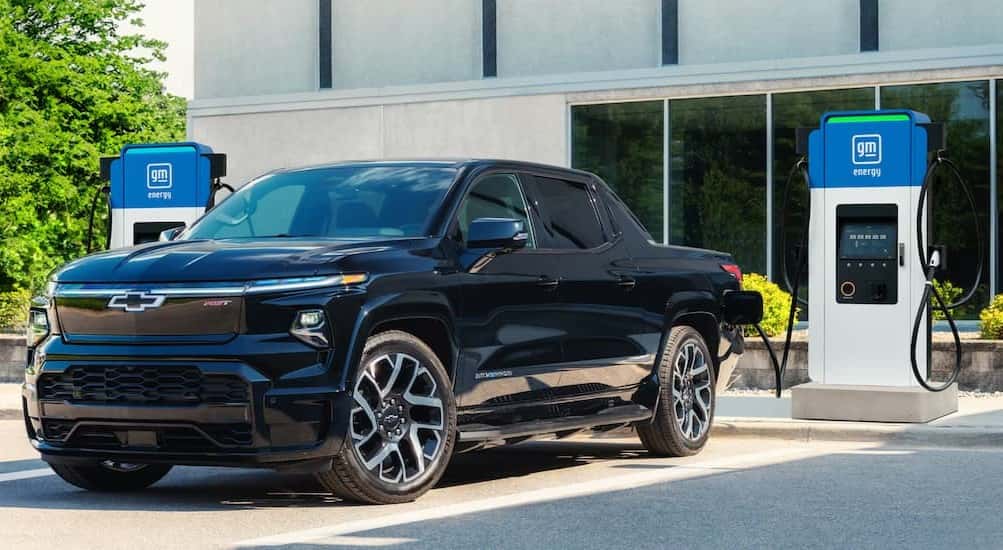
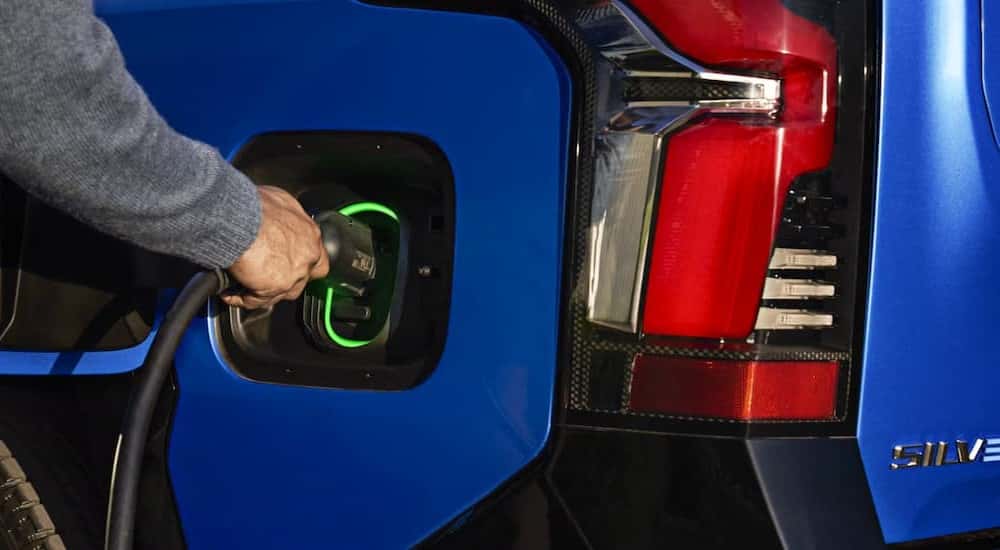
Driving a pickup truck isn’t a hobby; it’s a way of life. That doesn’t mean it can’t be expensive to enjoy your favorite hobby, with gasoline and diesel prices constantly fluctuating. A new age of truck driving will leave the pump behind and replace it with an electric charge that sees you enjoying your truck and all the power it offers without spending money on gas once or twice a week. Instead, you can charge your truck at home overnight or on the go and return to a full battery when it’s time to hit the road again. Today, we’re reviewing the 2025 Chevy Silverado EV vs 2025 Ford F-150 Lightning to see how these competitors stack up and help you determine which model is best for you. Let’s begin!
Which Truck Is More Powerful?
The 2025 Silverado EV and 2025 Ford F-150 Lightning aren’t made equal. One truck is stronger than the other, and one is more efficient. Plot twist: The stronger of the two is also the most efficient. Which truck are we talking about? The 2025 Silverado EV. Chevy has kept everyone in the dark regarding the size of its batteries. Still, it’s fair to assume the RST trim has its predecessor’s 200-kWh battery, as evident by its similar (and even better) performance output. We’ll swing back to this powertrain momentarily because the arguable star of the show is the new standard powertrain that manages to reduce the 2025 Silverado EV’s starting price by more than $20k compared to last year’s model.
Although Chevy hasn’t announced the battery size of the 2025 Silverado EV’s base powertrain, we do know it runs in a dual-motor configuration, meaning acceleration remains quick and smooth. And, while we don’t know its exact size, it’s fair to determine that the base battery is larger than the 98-kWh battery that comes standard with the F-150 Lightning. How do we know this? We determined this by comparing the 2025 F-150 Lightning’s base powertrain’s 452 hp to the Silverado EV’s base 645 hp. This is a large 43% horsepower increase, though the F-150 Lightning holds up well with its 775 lb-ft of torque compared to the 785 lb-ft of torque of the Silverado EV. It’s also worth noting that both models have standard AWD for each truck.
As mentioned, despite the massive horsepower advantage that Chevy’s base Silverado EV powertrain has over the F-150 Lightning, it’s also more efficient. Fully charging each battery nets you an estimated 240-mile travel range on the base F-150 Lightning, which pales in comparison to the estimated 408 miles you’d get with a base Silverado EV. To put that in perspective, the 2025 Silverado EV’s base powertrain has a 70% travel range improvement over the F-150 Lightning’s, in addition to the 43% horsepower boost.
Does the F-150 Lightning’s standard battery have any advantages over the Silverado EV’s? Yes, there’s one: The F-150 Lightning has a payload capacity of 2,000 lbs, while the Silverado EV sits at 1,800 lbs. However, this is quickly forgotten about when you stack the Silverado EV’s 12,500-lb maximum towing capacity against the F-150 Lightning’s 7,700-lb capacity—a massive 62% improvement in towing performance for Chevy’s electric truck.
Chevy’s truck remains stronger and more efficient when comparing the larger batteries. The larger 131-kWh battery available for the 2025 F-150 Lightning can output 580 hp while keeping its impressive 775 lb-ft of torque. Its towing performance improves to a 10,000-lb maximum capacity, but its payload capacity drops to 1,800 lbs, matching the Silverado EV. Despite the horsepower and towing improvements over the base battery, the 131-kWh battery for the F-150 Lightning is more efficient, with a travel range of up to 320 miles. Everything looks great until the Silverado EV enters the picture and all of Ford’s hard work comes tumbling down in grandiose fashion.
For a battery that we don’t know the size of yet, it’s already causing problems for Ford. The 2025 Silverado EV RST’s battery takes it up a notch, with 760 hp and 785 lb-ft of torque thwarting Ford’s efforts. It keeps the 12,500-lb towing capacity that already beats the F-150 Lightning’s capabilities, too. Performance isn’t all that’s been improved, as the 2025 Silverado EV RST has an estimated 460-mile range, meaning you’re not only getting more power than the F-150 Lightning’s largest battery, but you’re also getting one that’s 44% more efficient.
Does Ford Realize That It’s 2025?
Time flies fast, and it won’t be 2025 forever. However, that doesn’t mean you should buy a vehicle that feels like it belongs in the past. Some may not consider it, but infotainment centers play a large role in making a vehicle feel either fresh or outdated. This is because technology evolves at a rapid rate, and what was once fast and cutting-edge soon becomes bland and slow.
And it’s not all about function; form is important, too. We’ve all seen technology that instantly dates it in a specific time, whether it’s the chromatic and Frutiger Aero designs of the early to mid-2000s or the woodgrain paneling of the 1970s. An infotainment center’s appearance, including its size, can either give a modern aesthetic or one that’s firmly rooted in last-gen technology.
How does this all relate to the 2025 Silverado EV and F-150 Lightning? It’s simple: The 2025 Silverado EV has a standard 17.7-inch infotainment center on every trim, while the 2025 F-150 Lightning has a 12-inch screen. We’ve seen 12-inch infotainment centers for years, but only now are many manufacturers embracing large, sometimes panoramic-style displays that are visually pleasing now and unlikely to become unappealing anytime soon.
Fortunately, the F-150 Lightning has an optional 15.5-inch infotainment center. The problem is that it’s not standard, and it will cost at least several thousand dollars more to get an F-150 Lightning with a larger screen as opposed to the one in its base trim. Although GM indeed dropped Apple CarPlay and Android Auto support from its EVs, including the Silverado EV, it makes up for it with Google Built-In, with a dedicated app store, media apps, and more included.
How Much Cargo Space Is Available?
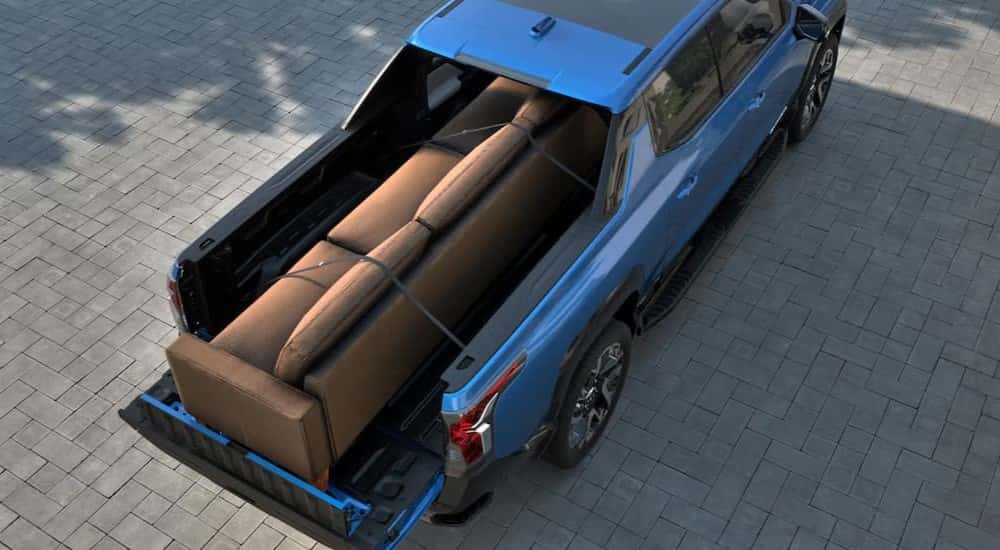
The 2025 Silverado EV and F-150 Lightning have something that no other trucks in their respective lineups have: front-end storage. Manufacturers have different terms for it, with Ford opting to call it a “frunk,” playing on the words “front” and “trunk,” and Chevy naming it the “eTrunk.” Best of all, frunks and eTrunks don’t take away from an electric truck’s traditionally excellent cargo space within its bed. And these are indeed impressive beds.
The 2025 Silverado EV has a 5.9-foot bed, and the F-150 Lightning has a 5.6-foot bed. How this translates into available cargo space is as such: the 2025 Silverado EV has 57.7 cu.ft. of cargo room in its bed compared to the 52.8 cu.ft. of the F-150 Lightning’s cargo bed. In their front trunks, the Silverado EV has 10.7 cu.ft. of additional storage, which falls slightly short of the F-150 Lighting’s 14.1 cu.ft. of space. However, when you combine the eTrunk with the bed’s available room, the Silverado EV ultimately comes out on top with 68.4 cu.ft. over the F-150 Lighting’s 66.9 cu.ft. of maximum space.
As the Old Saying Goes…
There hasn’t been a better time to pull out the adage “You get what you pay for” when comparing the 2025 Silverado EV and the 2025 F-150 Lightning. Is Chevy’s electric truck pricier than Ford’s? Yes. Is it stronger and more efficient, with more premium tech and more cargo space? Again, that’s an emphatic yes. You won’t regret spending the extra money on a Silverado EV over the F-150 Lightning, especially in the long term. We give it our biggest endorsement possible, and we encourage you to get behind the wheel of one today.

0 comment(s) so far on The 2025 Silverado EV Bests the 2025 Ford F-150 Lightning in All Areas