



The Silverado EV vs the F-150 Lighting: Which is the More Useful Electric Truck?
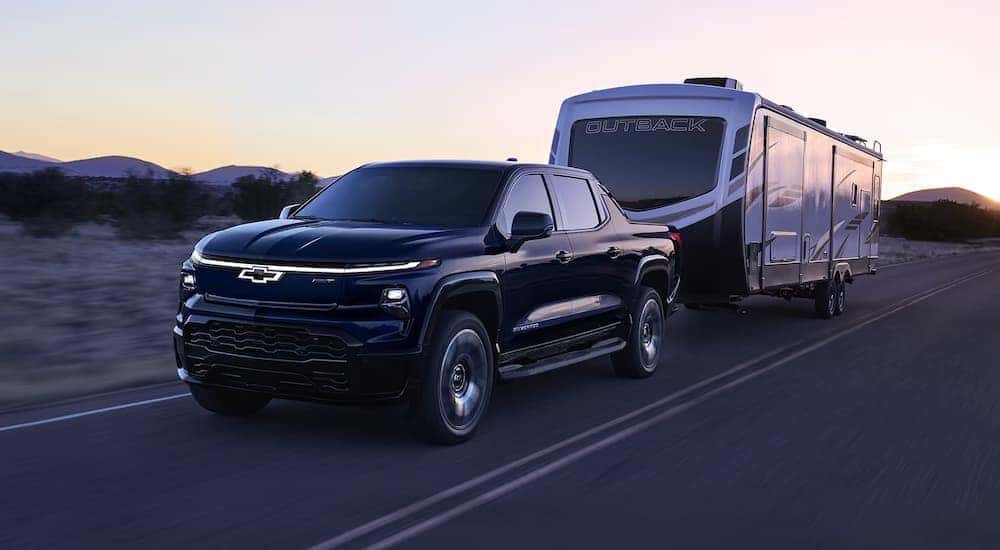
EVs aren’t just tiny commuter cars anymore—the future is here, and you can now get an all-electric pickup truck capable of getting serious work done. Several options exist, including models from relatively young companies like Rivian and Tesla, but if you want to stick with a tried and true American automaker that has decades of experience building trucks, it all comes down to Chevy and Ford, and the 2024 Chevy Silverado EV vs 2024 Ford F-150 Lightning.
Ford and Chevy took two different approaches when designing their electric pickups. Ford took the F-150 and made it an EV, resulting in a model with a similar look and feel to the traditional gas-powered F-150. Chevy, on the other hand, designed their electric truck from the ground up as an EV, so while it wears the Silverado name, it’s not restricted to the platform of the traditional gas-powered Silverado.
Which one of these approaches resulted in a better truck? We could look at that from all kinds of angles, from aesthetics to comfort. But what most truck drivers really value is utility. So, let’s get down to brass tacks and see which automaker has made the most useful electric truck. We’ll look at some of the most common tasks drivers need their trucks to handle and compare how each of these EVs performs.
Performance and Range Options
Whether you need a truck for work or just like to have a cargo bed handy in case you need to get a new couch or fridge, there’s one thing you’ll definitely do with your truck: drive it. So, how do these electric models do out on the road? They both feature a two-motor powertrain that gives them standard all-wheel drive (one motor for each axle), so you’ll have the torque you need to confidently drive dirt roads, gravel driveways, or wet freeways.
Looking into more of the specs, you’ll start to see some differences. The base WT model of the Silverado EV produces 510 hp and 615 lb-ft of torque, while the First Edition RST can produce up to 754 hp and 785 lb-ft of torque with the Wide Open Watts feature enabled. The F-150 Lightning clocks in at just 452 hp and 775 lb-ft of torque with the standard-range battery and 580 hp and 775 lb-ft of torque with the extended-range battery. The Silverado is significantly more powerful, letting you reach highway speeds quickly, pass confidently, and get your thrills out on the road without any other consideration.
When it comes to EVs, most drivers are less concerned with how fast you can go and more concerned with how far you can go, but again, the Silverado overtakes the F-150 in this regard. The base trim of the F-150 Lightning with the standard-range battery gets you just 240 miles of range. That increases to 300 miles if you opt for the Premium trim (at a considerable cost increase) and tops out at 320 miles if you get the extended-range battery. The Silverado beats that top figure on the 3WT trim, which offers 393 miles of range, and the RST First Edition blows it out of the water with 440 miles of range.
The Silverado EV’s More Versatile Truck Bed
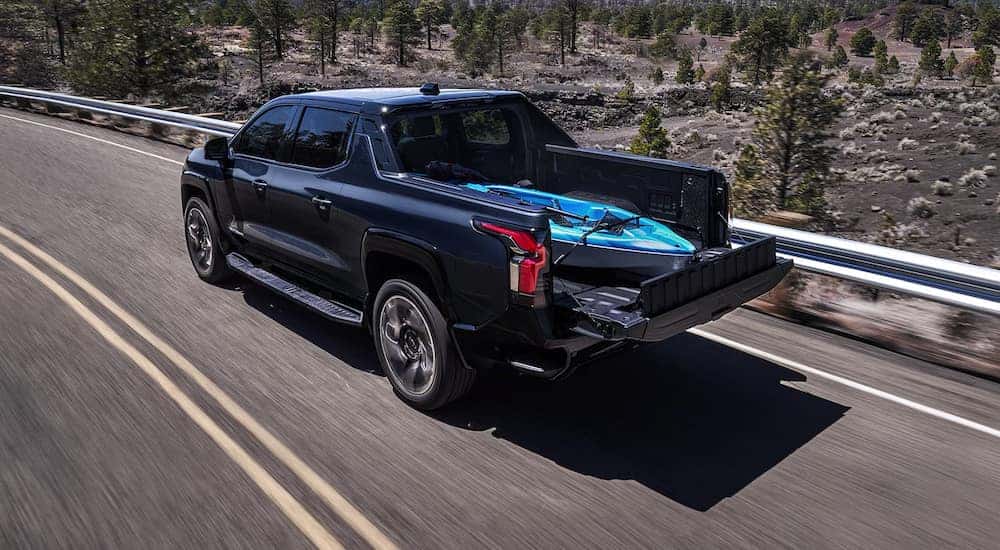
The Silverado EV nets a maximum payload capacity of 1,440 lbs, presenting a clever solution to help you with volume in place of the higher payload capacity of the F-150 Lightning. Chevy fans may remember the Avalanche from 2001-2013, a model that billed itself as a truck/SUV combo that had a “midgate” allowing cargo to stretch from the bed into the cab. The midgate has made a triumphant return on the Silverado EV. You can fold the rear seats of the truck down (either entirely or partially, thanks to a 60/40 split), fold the midgate flat, and even remove the rear window if necessary to accommodate extra-long cargo without struggling with bungee cables. While you’re confined to a bed length of 5.6 ft in the Ford, the Chevy gives you 5.9 ft in the bed and over 10 ft total with the midgate open.
Trailering Tech
This is a category where the F-150 Lightning and Silverado EV are pretty evenly matched. When properly configured, both trucks have the same max trailering capacity, and both trucks also have plenty of tech to help you tow. Some of these features are essentially the same on both, like trailer brake controller, hitch guidance, trailer coverage for the blind spot warning system, and camera views that help you keep track of your surroundings at low speeds. While Ford has a few tech features that aid with trailering, Chevy has set up the Silverado EV for four-wheel steering for enhanced stability and handling with a trailer in tow.
An added bonus for those willing to opt for it is Chevy’s SuperCruise with Trailering. This hands-free cruise control system allows you to let your Silverado EV take on thousands of miles of roadways across North America with automated steering, lane centering, and compatibility with Adaptive Cruise Control to manage acceleration and braking while maintaining a driver-selected following gap with any vehicle ahead of you, all with a trailer in tow. Ford’s BlueCruise does not accommodate trailers, forcing you to go manual if hauling a trailer over long distances.
Power and Outlet Options
You can use either truck’s battery to power more than just your motors. Both feature systems that essentially work like portable generators, allowing you to plug in your power tools at a remote work site (or power a mini fridge at a tailgate party). Both trucks offer a variety of outlets, and both can be used not only to power tools and small appliances but also to “jump-charge” other EVs or even power your home in the event of a blackout. Ford’s Pro Power Onboard system offers up to 9.6 kW of power when properly equipped and only through four outlets. In comparison, Chevy’s PowerBase system can provide up to 10.2 kW through six 120V outlets and one 250V outlet.
Off-Roading
The F-150 Lightning is entering its third model year for 2024 but still has yet to offer an off-road trim. Though a concept trim called the Switchgear has stirred up buzz that one might be coming in the future, nothing is confirmed. The Silverado EV doesn’t have an off-road trim available yet, but Chevy has already announced that a Trail Boss trim will be part of the lineup. We know that Chevrolet’s parent company, General Motors, already has what it takes to make an electric off-road pickup because they’ve done it already.
Similar to the GMC Hummer EV Pickup, we can expect the Silverado EV Trail Boss to deliver a suite of standard off-road features, including front and rear driver-selectable electronically locking differentials, full underbody skid plates, rocker protectors with assist steps, recovery hooks, waterproof front and rear underbody cameras. The adaptive air suspension system on the Hummer EV allows you to use “extract mode” to lift the truck up and over obstacles from boulders to standing water, while the four-wheel steering allows for “CrabWalk,” which lets the truck move diagonally to get out of tight spots. Since the Silverado EV already offers air suspension and four-wheel steering, we wouldn’t be surprised to see a Trail Boss that offers similar clever and useful features.
The Silverado EV Charges Ahead
Ford may have released the F-150 Lightning a few model years earlier, but clearly Chevy took the time they needed to get everything just right. By building a whole new platform from the ground up, they’ve been able to design every detail with electric power in mind, helping them deliver more power, more range, and more useful features. If you’re interested in getting a pickup truck that works hard without burning fossil fuels, the Silverado EV is the way to go.

0 comment(s) so far on The Silverado EV vs the F-150 Lighting: Which is the More Useful Electric Truck?